I wish I knew how personally devoted Pharaoh Kleopatra VII was to Isis.
Was she a true devotee of the most well-known and powerful Egyptian Goddess of her time? Was her identification of herself as “The New Isis”—just as her father, Ptolemy XII, had called himself “The New Dionysos”—merely a political stratagem? Was it some combination of both? Were there other reasons?
Let’s look for clues.
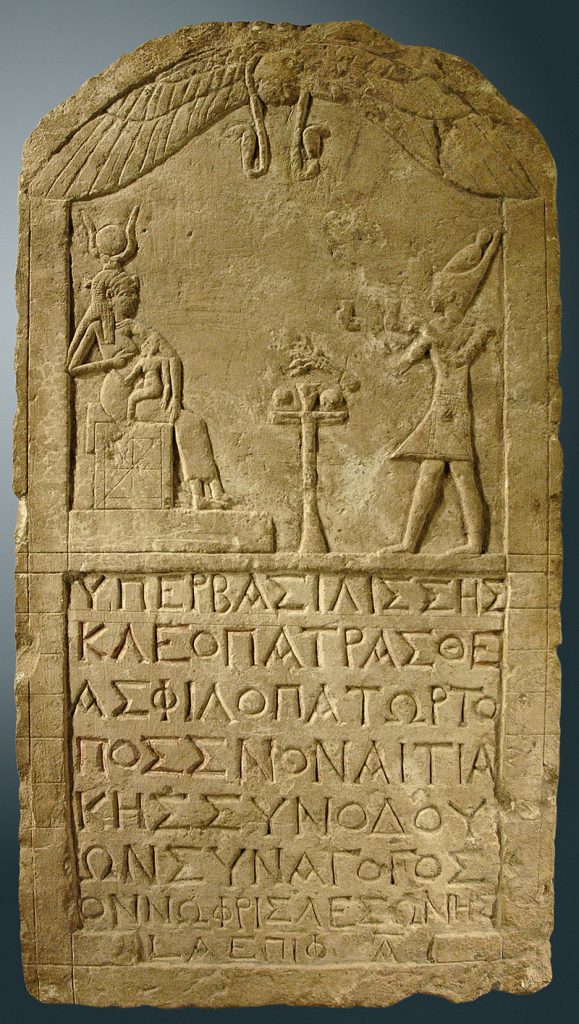
The stele here shows Kleopatra (you can see her name in Greek on the second line from the top) as a male pharaoh making offering to Isis Who is nursing Horus. The Greek text reads, “For Queen Kleopatra, the Father-Loving Goddess, this place [topos] of the synod [a group or assembly of people] of Snonaïs [an epithet of Isis], whose synagogue leader is Onnophris [this is a personal name in this instance, but it is also an epithet of Osiris]. Year 1, Epiphi 1.”
So, this limestone stele was dedicated by the head of a private group of worshippers of Isis Snonaïs to Kleopatra, showing their loyalty to the queen. It was dedicated in “Year 1,” that is, the first year that Kleopatra took the throne in 51 BCE at the age of 18. So, from the very first, Kleopatra was clearly associated with the Goddess, and with worshippers of Isis.
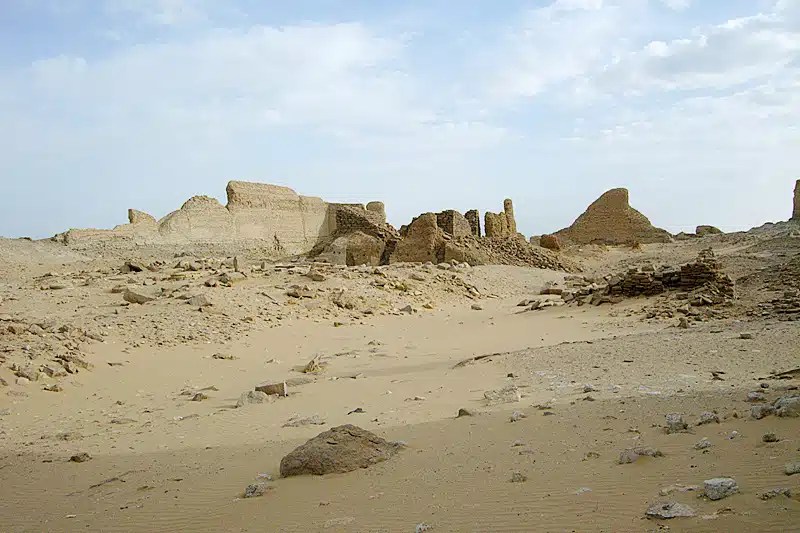
The stele is from the Faiyum, where Isis was often worshipped with the local Sobek, Lord of Crocodiles, and where Isis might also take the serpent form of Isis Thermuthis (a syncretism of Isis and Renenutet). The group had a physical place where they worshipped (the topos), and from the names researchers have been able to connect with the group, they seem to have all been men.

Isis Snonaïs is a local form of the Goddess worshipped in the Faiyum. Egyptian Goddesses and Gods were often given place-name epithets, drawing them closer to their local worshippers. While there’s no town in the Faiyum of that name, some scholars have suggested that the epithet might be connected with the temple of Sobek called Soknopaiou Nesos, the “Island of Sobek, Lord of Pay.”
The temple there is dedicated to Sobek Soknopaios and Isis Nepherses. Nepherses comes from Egyptian nfr st, “Beautiful Throne” or “Beautiful Place,” but, since “st” is also a part of Isis’ name, some Egyptian wordplay was surely intended, and which can be interpreted as, “Beautiful Isis.” In a text known as the Book of the Faiyum, Isis Nepherses is said to be “beside Sobek of Genut [unknown place], at peace on Her hill, this place is in Her name, it is the place of the flood,” (And, so now I am imagining Her temple as a high place, while the land below is flooded during the Inundation. A holy place, indeed.)
There’s a lot more that’s of interest about Isis Nepherses, but since we’re on Kleopatra’s trail, we’ll come back to Her another day.
As you know, the Egyptian pharaoh and the royal families were, from the earliest times, closely connected with Deities. The living pharaoh was Horus—as well as the son of numerous Goddesses and Gods. The Egyptian queens partook of the Divine power of the Two Ladies: Isis and Nephthys, or Nekhbet and Wadjet, as well as other important Goddesses like Hathor. And of course, Egypt also had female pharaohs.
When the Ptolemaic dynasty came to power, the Ptolemaic queens took advantage of this Egyptian tradition of powerful women to gain authority, influence, and wealth for themselves. Arsinoë II was identified as “king” in Egyptian sources. Berenice II was called the Female Pharaoh, and Kleopatra I ruled with her son Ptolemy VI, both as pharaohs. In fact, all the Ptolemaic queens held a great deal of power, whether recognized by a specific title, such as pharaoh, or ruling as regents with an often-much-younger male relative.

It was also Ptolemaic tradition for the queens to identify with powerful Goddesses. On top of their list were Isis, Aphrodite, Hathor, and Demeter. Scholars studying these queens believe that this religious identification with Goddesses was essential in helping the queens gain and retain power—but it also led to greater opportunities for many more-ordinary women in Egypt to participate in Hellenistic society in expanded roles.
The Roman poet Lucan, in his On the Civil War, writes disparagingly about Kleopatra. He has her say to Caesar as she asks for his support, “I will not be the first woman to rule the cities along the Nile; gender makes no difference in Egypt. This land knows how to be ruled by a queen.” In Lucan’s opinion, this was, of course, a terrible and degenerate thing. His work was among the volumes and volumes and volumes of nasty Roman propaganda against Kleopatra, which both preceded and followed her death.
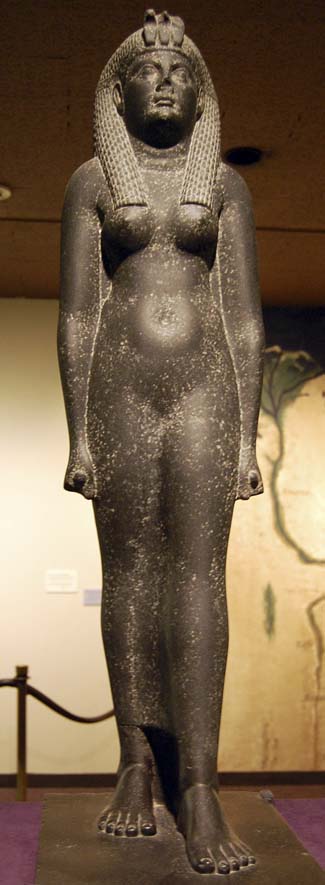
Yet, while the Ptolemaic queens did identify with other important Goddesses, their identification with Isis was the most frequent. In this way, Kleopatra VII was following in the already deep-set footsteps of her foremothers. Egypt’s last pharaoh, however, took her identification with Isis to a new level, appearing in public as “the New Isis.” Plutarch, in his Life of Antony, tells us that Kleopatra “both then and at other times when she appeared in public, assumed a robe sacred to Isis, and was addressed as the New Isis.”
And there was good reason for her to do so. It would not be out of line to say, quite simply, that Isis was THE most well-known and well-loved Goddess in Hellenistic Egypt. What’s more, Her worship was widespread outside of Egypt and throughout the Mediterranean world, too. She was worshipped in much of the Roman world, as well. In Pompeii, for instance, scholars estimate that a full ten percent of the population were Isis devotees. And this in a polytheistic world. Isis’ popularity would have been politically important in Kleopatra’s dealings with Rome. Read about Isis in Rome here. On the other hand, Isis temples and Isis worshippers in Rome went through periods of severe disfavor. There was suspicion about this foreign cult—and thus suspicion about this foreign queen, clearly representing the suspicious Goddess Isis.
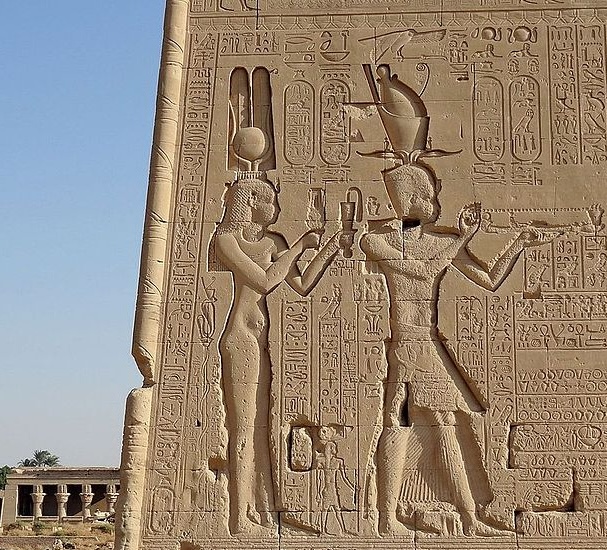
Kleopatra’s public identification with Isis is very well known. In Egyptian texts, she is called Daughter of Geb, Who is, of course, Isis. Interestingly, as king, she took a Horus Name, but it was a Horet Name, a Female-Horus Name. (In case you were wondering, it was Weret-Tut-en-Ites, “Great Image of Her Father,” very similar to her Greek epithet, Philopator, “Father-Loving.”) Kleopatra was titled, “Queen of Upper Egypt, land of the White Crown; Queen of Lower Egypt, Land of the Red Crown.” Goddesses, including Isis, were frequently called by this and similar queenly titles.
When Kleopatra gave birth to Julius Caesar’s son, whom she called Caesarion, and whom she would eventually crown as king beside her, Kleopatra began connecting herself and Caesarion with Isis and Horus.
When Caesar had his “Et tu, Brute?” moment while Kleopatra was visiting him in Rome, the Isis and Osiris myth came to life for her even more palpably. Her Roman ally, and the father of her child, was dead. As she speedily returned to Alexandria, now she was a grieving widow with a fatherless son, just as Isis was. And while she had often identified with Isis, her Pulitzer Prize-winning biographer, Stacy Schiff, says that following this return to Alexandria from Rome, the Isis-Kleopatra identification really took off.
If Caesar had returned from Alexandria [after spending time with Kleopatra and begetting Caesarion] more royal than before, Cleopatra returned from Rome more godly. She vigorously embraced her role as Isis, with full emphasis on her maternal command . . . At festivals, she appeared in her striking Isis attire.
Stacy Schiff, Cleopatra, a Life
And I see that, once again, the length of this post has gotten away from me. So, that’s enough for now. Next time, we’ll see how Kleopatra’s “godliness” manifested, speculate on the queen’s devotion to the Goddess, and on whether she thought she really was Isis.

