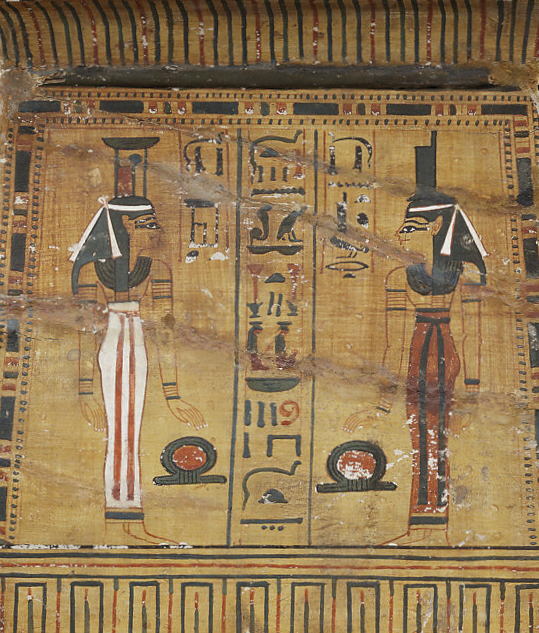
I’d like to introduce or, for some of you, reintroduce you to two rather obscure Goddesses, Who—in that delightful and ever-so-typical ancient Egyptian way—both are, and aren’t, Isis and Nephthys. Egyptologist Sylvie Cauville calls Them “avatars” of Isis and Nepththys.
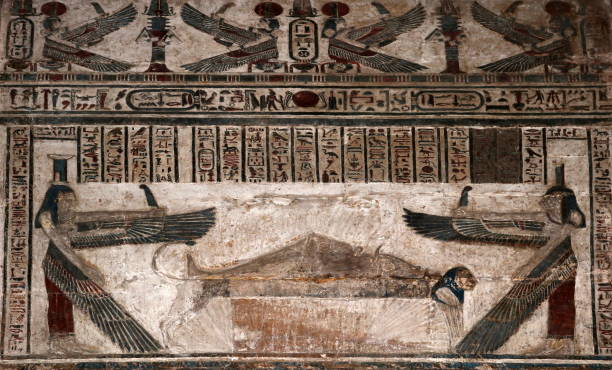
Most of our evidence of Them comes from Abydos, Edfu, Dendera, and Philae, and They are, unsurprisingly, involved in the resurrection of Osiris, especially in relation to the Great Festival of the God in the Egyptian month of Khoiak, roughly around Halloween. If you’re not familiar with those rites, learn more here.
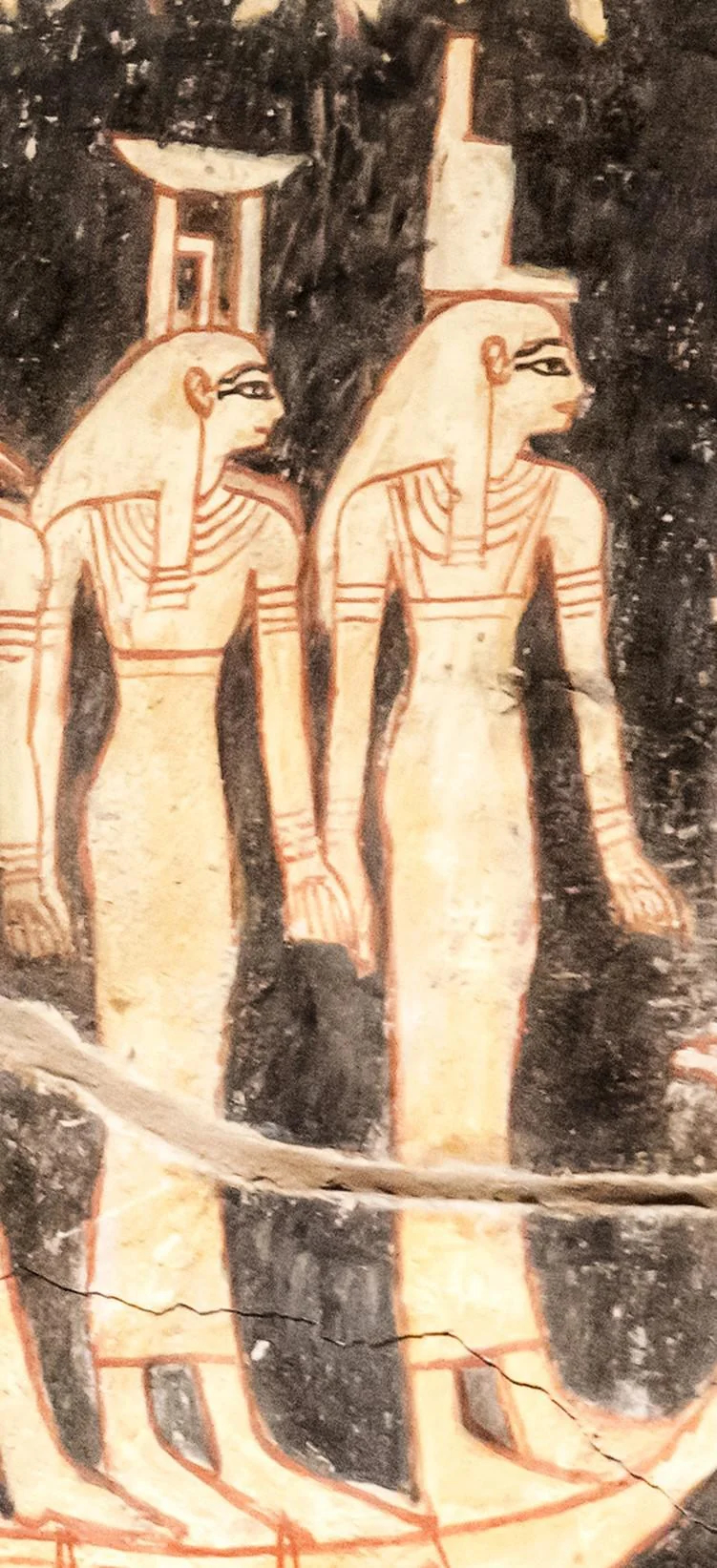
The two Goddesses are Shentayet and Merkhetes. We find Them as Isis-Shentayet and Nephthys-Merkhetes in the temples, though Their names are also given separately from those of the Two Sisters, as well as in parallel with Them. Shentayet is the more prominent of the two. While She is usually connected with Isis, at Edfu, we have one instance of a Nuet-Shentayet. The Pyramid Texts also connect Nuet and Shentayet.
There is some Egyptological discussion about the derivation of Shentayet’s name. Some derive it from śni, the active participle of “to encircle.” At Dendera, Shentayet is called She Who Encircles the Mounds. A similar word šn (shen) means “to encircle to protect.” It also means “eternity;” the royal cartouche is an elonged shen symbol. It encircles the names of the royals, and thus protects them for eternity. Isis’ magical wings, as they protect Osiris, can also be seen as encircling Him.
Another option for the derivation of Shentayet’s name is from šni, meaning “to suffer,” which would fit with Her mourning aspect; Shentayet is She Who Suffers. Šntbyt became a common word for a widow, a woman who suffers the death of her husband, as Isis suffers the loss of Osiris. Shentayet is specifically called the Widow in a number of temples, which makes sense, especially when She is Isis-Shentayet. Isis disguises Herself as a young widow in the myth of the Contendings of Horus and Set in order to make Set admit to His attempted usurpation of Horus’ throne. Isis is also alluded to as a widow, and Horus as an orphan, in the magical papyri (PGM IV 2373-2440).
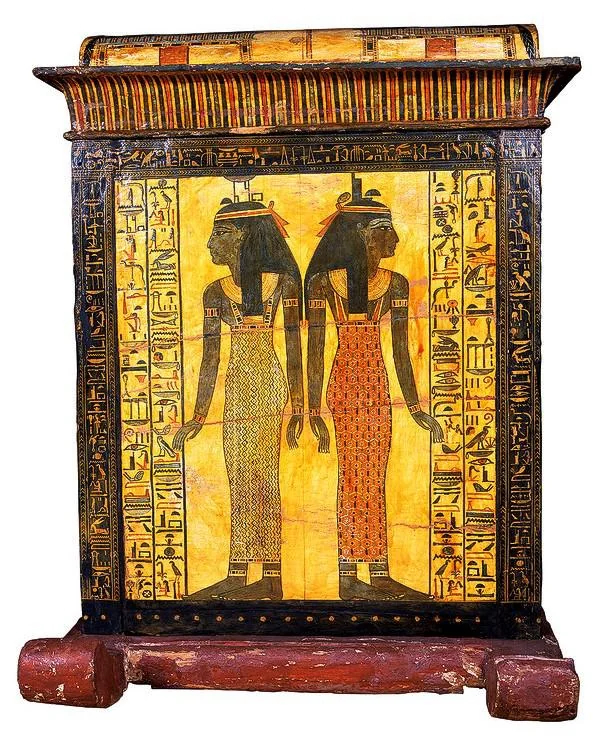
Another related word, šnn, has also been conjectured as a possible derivation of Her name. Šnn is the hair Egyptian widows might tear from their heads during mourning. At Koptos, where Isis was particularly revered as a Mourning Goddess, there is a record of a healing prayer made “near the hair at Koptos.” Scholars consider this a reference to Isis’ hair. Perhaps Koptos preserved a relic of Her mourning: a lock of Her powerfully magical hair. Shentayet also appears in Koptos, where a text says, “There is perfume in Your hair, O Shentayet.” Shentayet was also called Mistress of the City at Koptos, so She was important there. I can’t say from the materials I have access to, but I wonder whether “the hair at Koptos” was a perfumed lock of the Divine hair of Isis-Shentayet. There is a lot of Egyptian lore connected with hair and death, which you can read about here.
The main cult centers for Shentayet were Abydos and Busiris (Djedu). But She is also included in temples where the cult of Osiris was prominent. Interestingly, at Abydos, where Shentayet can take the form of a Divine Cow, She is shown with the headdress of Isis. The Shentayet of Djedu, however, was shown with the headdress of Nephthys. (So, in addition to our Nuet-Shentayet, perhaps we have a Nephthys-Shentayet?—although we don’t find that name in the inscriptions.) At Isis’ Philae temple, Osiris is mourned by the Two Shentayets, the Shentayet of Abydos and the Shentayet of Djedu (Busiris).
As a cow-headed Goddess, Shentayet can wear the Double-Feather crown, the Horns and Disk crown, the Throne of Isis, and sometimes a Ba-et necklace. Isis-Shentayet at Edfu is called “the Powerful One Whose image is that of the Primeval Goddess, Great and Majestic, Shentayet, the Spinner.” Shentayet is called Lady of the Golden Grain (we’ll see why in a minute), Daughter of Geb in the House of Nuet, She Who Protects the Body of Her Brother, as well as Guardian of Osiris, and Keeper of Osiris.
Merkhetes’ name is more easily decoded. Merkhetes is “She Whose Flame is Painful,” which refers to Her protective and fire-spitting Uraeus Goddessform. In addition, both Merkhetes and Shentayet are shown winged for Their protective functions. While Shentayet can be found on Her own, Merkhetes is always named or shown with Shentayet.
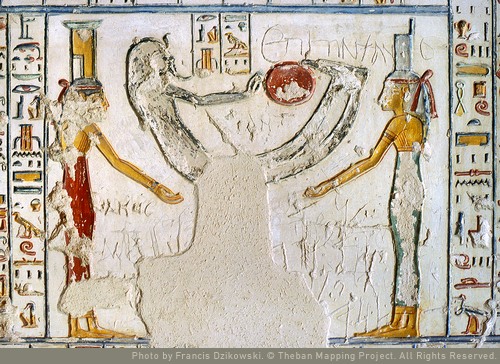
At Edfu, we find Shentayet and Merkhetes paralleled with Isis and Nepththys, so it’s easy to see how the Goddesses were aligned: “The Two Sisters are with Him [Osiris]; They command His protection, it is Isis with Nephthys, it is Shentayet with Merkhetes, Who extol the perfection of Their brother.”
Other Edfu inscriptions tell us that Merkhetes “revives the flesh of Her brother with Her sister Shentayet.” We can see Nephthys almost defined as Merkhetes in this inscription: “Nephthys, the Sister of the God, Who Resides in Edfu, Merkhetes Who Protects Her Brother.” Nephthys is also called “the Temet” in the House of Gold Who Laments Over Her Brother. “Temet” is a feminine word, and refers to the death shroud, so the Goddess Herself is a shroud, covering Osiris. Nephthys-Merkhetes is called “fire-breathing,” and She is the One Who Makes Hearts Ache, Merkhetes With a Sorrowful Heart, Who Protects Her Brother in the Wabet [the place of purification]. At Dendera, we read, “Words to be spoken by Merkhetes Who presides over the House of Shentayet, the Great Sorrowful One, Whose Heart is Sorrowful, She Whose Misfortunes are Sorrowful.”
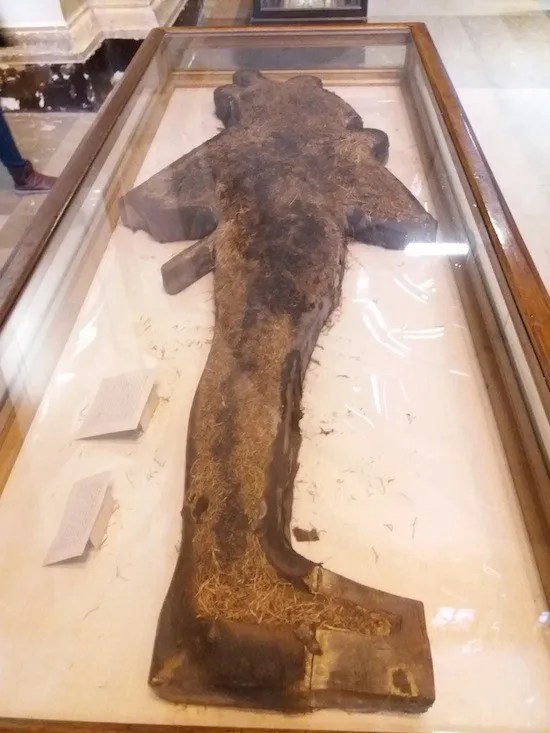
Now, here’s what I think is the most interesting part of all this. It seems that both Isis-Shentayet and Nephthys-Merkhetes took important roles in the Khoiak Mysteries of Osiris. In temples where the Egyptians celebrated these Mysteries each year, Shentayet and Merkhetes were key in actually putting together the “body” of Osiris that was used in these Mysteries.
Just as in the myth, where the Sisters search for and reassemble Osiris’ body, Isis-Shentayet and Nephthys-Merkhetes took part in creating the molded form of the God that would be created yearly, lamented over, buried, and then celebrated through the Raising of the Djed Pillar. The Osiris image was created from Nile mud, sand, water, wheat or barley, ointments, and surely various other magical amulets and elements. This was the “Corn Osiris” or “Corn Mummy.”
In the House of Shentayet, we see Deities bringing the ingredients that will be used to create the body of Osiris. Shentayet weighs them to ensure the right proportions, then “rejuvenates Her brother in the House of Gold,” She transforms the golden wheat into an image of Osiris, formed in a golden mold. At Edfu, Shentayet is She “Who makes the garden-vat green.” The “garden-vat” is where they mixed the ingredients before putting them into the Osiris mold. The Goddess is also called Regent of the House of Life of the Effigies, that is, the effigies of Osiris and Sokar that were made for the festival. While not mentioned much in the Khoiak Mysteries, Merkhetes is there with Her sister, helping to rebuild the God’s body and lamenting Him in Her sorrowful heart.
At Dendera, we learn about the making of this molded Osiris Khentiamentiu, Foremost of the Westerners:
“Making of the Osiris Khentiamentiu: On the twelth of Khoiak, at the fourth hour of the day, lead the Goddess Shentayet in procession, Who resides in Abydos, at the Place of the Festival of Earth Digging [you will also see this translated as “Festival of Hacking the Earth”]. The barley grains are placed before Her on a bed in the chamber of the House of Shentayet; She is erect, unclothed. On the twelth of Khoiak at the third hour of that day, the Goddess Shentayet, Who resides in Busiris, is exposed at the Place of the Festival of Earth Digging. There is earth before Her inside a wooden chest. She is placed on a bed in the chamber, facing north, and stands unveiled.”
The fact that the Goddess is unveiled and is in a bed chamber would seem to suggest some symbolic sexual alchemy. The wheat or barley, and the earth in a wooden chest, is charged by being in rejuvenating union with the Goddess, then the wheat and other ingredients for the God’s body are mixed in Her garden-vat, so that the effigy of the God can be created from the mixture. The molded Corn Osiris is watered so that the grains sprout, demonstrating ongoing life.
After all the rites, lamentations, and burial, the Djed Pillar is raised, by Isis and Her son, the king and Osiris’ heir, to ensure the ongoing stability of Egypt. Depending on where the festival was held, there might be more rites after this, but everything ends in a celebration and feast—as all good festivals must.
So what can we do with this information in our own, smaller, more personal festivals? We can certainly add Isis-Shentayet and Nephthys-Merkhetes to our prayers and invocations—especially around Halloween, when our thoughts turn to those in the realm of the dead.
But have you ever made a Corn Osiris? Here’s a post about one I made for a festival in California. It might give you some ideas about how to make your own. If I were doing it again (which I most likely will now that I know more about Isis-Shentayet and Nephthys-Merkhetes), I’d add much more magic to the mix of potting soil and invoke the Goddesses, the Two Sisters and Their Avatars, to be with me as I work.

