Like most of the ancient world, Egypt had a wide variety of types of divination. (As does our modern one, for that matter.) What’s more, judging by the scholars I’m reading, there is still a lot of unpublished material that would expand even further our current knowledge of the different divinations used in ancient Egypt.
Among the most popular types was divination through dreams. Dreaming is a psychic-divine communication that just about everyone has access to. What’s more, just about everyone is curious about their dreams.
It has never not been so.
In Egypt, sleep was considered a way to see into the otherworld. Nighttime returned the world to the primordial, with its danger of isfet, the opposite of ma’et. With dawn and the coming of light, ma’et returned. Dreamtime enabled people to get a glimpse into the normally invisible realms.
To uncover the meaning of their dreams, the Egyptians had dream-interpretation manuals. And we are fortunate to have parts of several of them, one written in hieratic, one in demotic (and possibly bits of other demotic ones). Yet, scholars think that the tradition of using dream interpretation books probably goes back at least as far as the Middle Kingdom. The hieratic version of the extant dream book lists over a hundred dreams considered good omens, followed by more than eighty bad-omened ones. The next section includes a spell to ward off the effects of a nightmare. Just one spell. And Who do you suppose it counseled people to call upon?
You guessed; it was Our Goddess Isis. Her Divine presence, along with some bread, beer, herbs, and myrrh, is the cure for having had a nightmare. The dreamer recites a formula about Horus waking from a nightmare and calling on His mother Isis to soothe Him. Isis comes to “drive forth thy ills.” Then the dreamer moistens bread and herbs with beer and myrrh, and cools their face with the mixture, “and all evil dreams that he has seen are driven away.” Not sure how I feel about wiping my face with beer-wet bread and herbs, but calling on Isis seems like a pretty good idea.

Most of the dream-book interpretations themselves are quite short and straightforward. If you dream X, then it means Y. Here are a few examples: “If a man dreams of a nemset-jug, he will prosper and the God will be merciful to him.” Or “if a man dreams of feeding his mother, his Goddess will be favorable toward him.” There are lists of woman-specific dreams, too. For instance, “If a woman dreams that a snake has sex with her, she will find herself a husband.” Yeah, we all get it. A snake.
One could also go direct to a Deity for information through dream by undergoing ritual sleep in Their temples. Today, his practice is usually known as “incubation.” From the New Kingdom on, ritual dreaming in the temples of Isis was common. At Saqqara, there is evidence for at least one actual oracle on the site; archeologists have found papyri with oracular questions addressed to Isis, to Osiris-Apis, and to Isis and Osiris-Apis together. They also know incubation was practiced at Saqqara, but, so far, they haven’t discovered much in the way of detail about it.
People incubating in the temples might seek divinatory answers to questions. Or, they might seek healing dreams, in which they hoped the Deity would provide a “prescription” of some sort to heal them. On the other hand, Isis is known to have used dreams to call Her initiates. People might also be given tasks to do for the Deities. We have votive stelae that explain that they were set up “in accordance with a dream.”
We also have the remnants, and reworkings, of direct-Deity-experience rituals in some of the spells in the Greco-Egyptian Magical Papyri (texts of magical spells written in Greek and/or Demotic Egyptian). Scholars generally agree that a great deal of what is found there is based on Egyptian technique, and may have developed from Egyptian temple rituals, or parts of temple rituals—even though many were written down in Greek. PGM I, 42-195 offers a very Egyptian-sounding spell for acquiring a magical assistant (referred to as both a “god” and an “angel”), which includes covering your eyes with a “black Isis band” and holding in your hand [I presume, an image of] a falcon’s head, while you invoke the assistant from your rooftop.
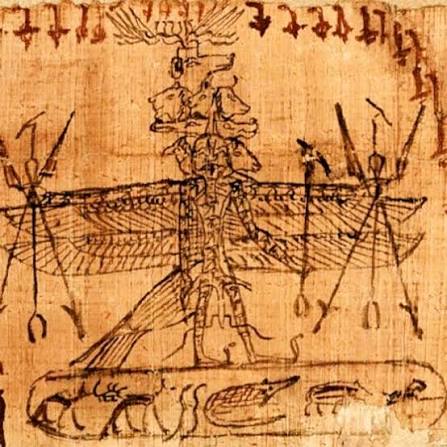
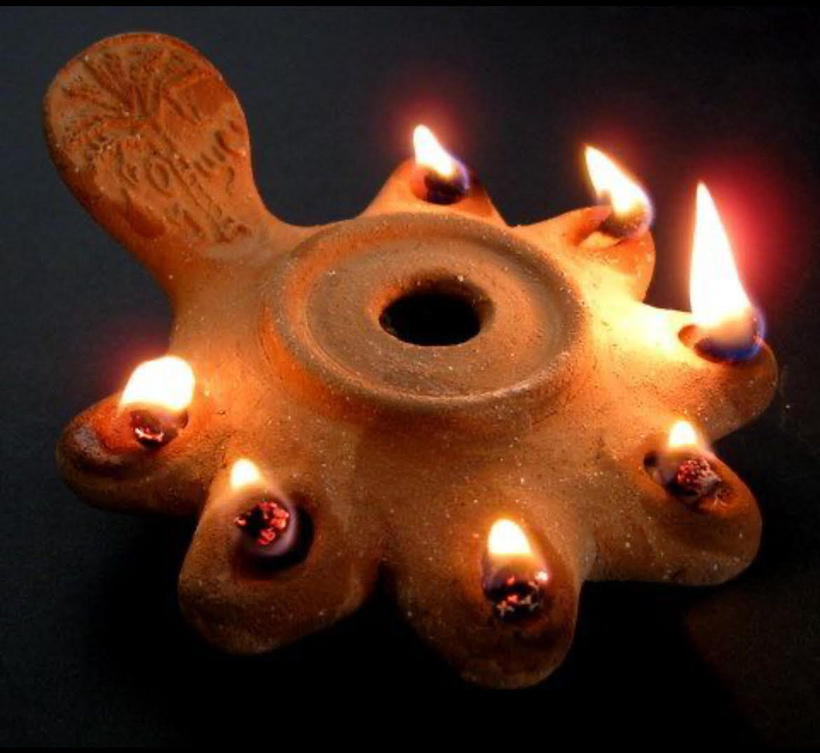
In other spells, the ritualist identifies with Horus as “a fatherless child of an honored widow.” The honored widow is, of course, His mother Isis. A “black Isis band”—sometimes a blindfold, sometimes a protective wrap—is a common ritual tool; other spells call for a “crown of Isis.” PGM IV, 3086-3124 is titled the “Oracle of Kronos,” but one should be dressed as a priest of Isis to do the working, which invokes Kronos to answer a question. A “lamp divination” (PGM VII, 540-78) uses a child oracle, who is identified with the child Horus, as “Beloved of Ouseiri, Beloved of Isi.”
In addition to dream oracles and ritual oracles, we know of many other types of divination in ancient Egypt. We have a manual on lecanomancy, scrying in a water-filled vessel. Another text gives us a list of omens, usually involving animals, and what each one means. Interestingly, following the list of omens, there is a singular, short spell for driving off the effects of bad omens—just as the hieratic dream book gives us an Isis spell to cure nightmares.
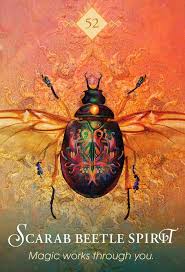
A papyrus from Saqqara has an example of using a scarab beetle for foretelling the future. Apparently, you drop a ball of dung in a container of some kind with the beetle and see what actions it takes. Its actions are interpreted to provide the results of the divination. This text also included theological explanations of the interpretations, so I am guessing that this was a divination method for temple personnel who would have more understanding of such explanations. I don’t have a copy of this text, but I’d love to find one.
Yet another type of divination could involve the drawing of lots and their interpretation. Just like Tarot cards. Archeologists have found strips of papyrus with numbers and meanings attached to them. They say, “number seven: it stands for Isis,” “number eight: it stands for Horus,” and “number ten: it stands for Neferhotep.” They have also found dice with Deity names on each side, so you can roll for your answer. In the magical papyri, there is a divinatory rite similar to the papyrus-strips one above, but using fronds from a palm tree. I played with a version of that rite, which you can read about here. It’s actually pretty cool.
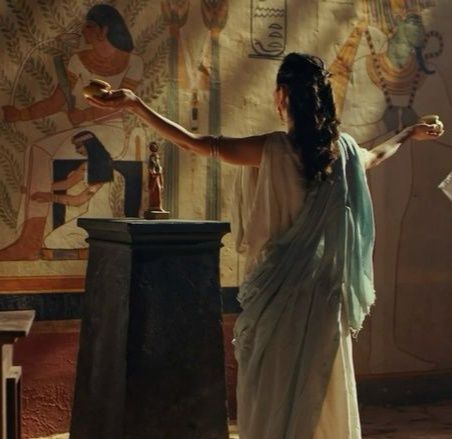
Yet another similar “die-casting” type divination is hinted at in a papyrus now in Vienna, and which seems to deeply involve Isis. In the text, we find sequences of three numbers that add up to either four, fourteen, or twenty-four. And they all represent questions posed by Isis—and directed to an item that may mean “stone,” or something similar, in demotic. So, all the questions in this divination are posed by the Goddess. I wonder: are you, the querent, acting as Isis when you cast the stone or stones or whatever it might be? Or do you, the querent, come before Isis—Goddess of Magic, Lady of Oracles—and request Her to ask the question on your behalf? How do the numbers work? I have so many questions!
This by no means exhausts the topic of divinations from ancient Egypt. We have not yet gotten to the famous boat oracles, which was a very common type of public divination. And yes, of course, Isis is involved. But I think we’ll take those up next week since this post has gotten long enough.
Have you ever devised any new types of divination under the Wings of Isis? I have a set of the Sacred Scarabs that deTraci Regula created. In fact, I have them right here. So, of course, I just reached in and grabbed one. Guess what I got? The Throne of Isis. I am not kidding, and O Goddess, I do love such synchronisities and omens.


Ive been on my spiritual journey with Isis for a little bit but I hardly ever get any dreams of the omen kind sometimes I wonder if its from blocks does anyone have any experience? I find it kind of awkward to imagine
Dreaming works for some folks and not so much for others. I’m not much of a dreamer myself. However, like visualization, dream perception is something that you can train yourself to get better at. Here’s a resource: https://share.google/NOM4VBhQeLk3wYMu3
since dreams are subjective how would you even have more omens or direct experiences in them. I cant say ive ever seen isis in a dream is it a thing you just have happen more over time?