I’m going to keep a little reminder at the top here for a while. If you plan to purchase the new 25th anniversary edition of Isis Magic, you can save 25% with the code ISIS25 at checkout from the publisher’s site. The offer is only good until 6/28/26, which is when the book is officially available.
Now on to our post of the day.

If you joined me at the Spirit Northwest Pagan convention a week or so ago, you know that we talked about the ancient Egyptian magical technique of “Kheperu,” and we tried it for ourselves in ritual. It is, quite simply, one of the most potent magical techniques we humans have available to us.
For those of you who couldn’t join us, here’s a super-quick summary of what Kheperu is:
We find the technique in ancient Egyptian funerary texts—Pyramid Texts, Coffin Texts, Books of the Dead, including the various lesser-known books. We find it in Hermetic literature, in the Greek Magical Papyri, in Coptic Christianity. We can follow it into the Western Esoteric Tradition, and then into magical and spiritual Work today. You may have heard of it as “Assumption of the Godform,” “Aspecting,” “Drawing Down the Moon,” “Embodying,” as well as other names. It is a genuinely ancient Egyptian technique, and it is used in both practical and religious magic.
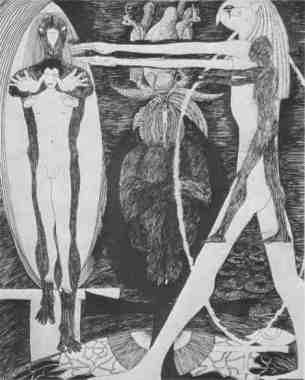
What is Kheperu?
Most simply put, whenever we find the deceased, the priestess, priest, or the magician claim TO BE a particular Deity and they speak in the first person, we are likely to be witnessing the technique of Kheperu. Kheperu is the voluntary taking on of the imaginal form of a Deity that enables the magician to share, albeit briefly, in the powers and Divine energy of that Deity—usually for the purpose of enhancing the effectiveness of a magical Working or for deep communion with that Deity.
Kheperu is a defining characteristic of Egyptian and Egyptian-derived magic. They often expressed it as “putting on the cloak,” “mantle,” or “shape” of a Deity. “I have put on the cloak of the Great Lady [Hathor, in this case], and I am the Great Lady,” says one Coffin Text. The Coffin Texts also tell us that the deceased “appears as Horus” or walks “on my feet like Osiris.” Another says the deceased, “will go up and take possession in the shape of Anubis.”
In the Book of the Dead, we learn that:
“Horus has invested me with his shape [. . .] I am the falcon who dwells in the sunshine, who has power through his light and his flashing. My arms are those of a divine falcon, I am one who has acquired the position of his lord, and Horus has invested me with his shape.”
“Kheperu” may have been what the ancient Egyptians called this technique—although we don’t know that absolutely. That’s certainly what I chose to call it in Isis Magic.
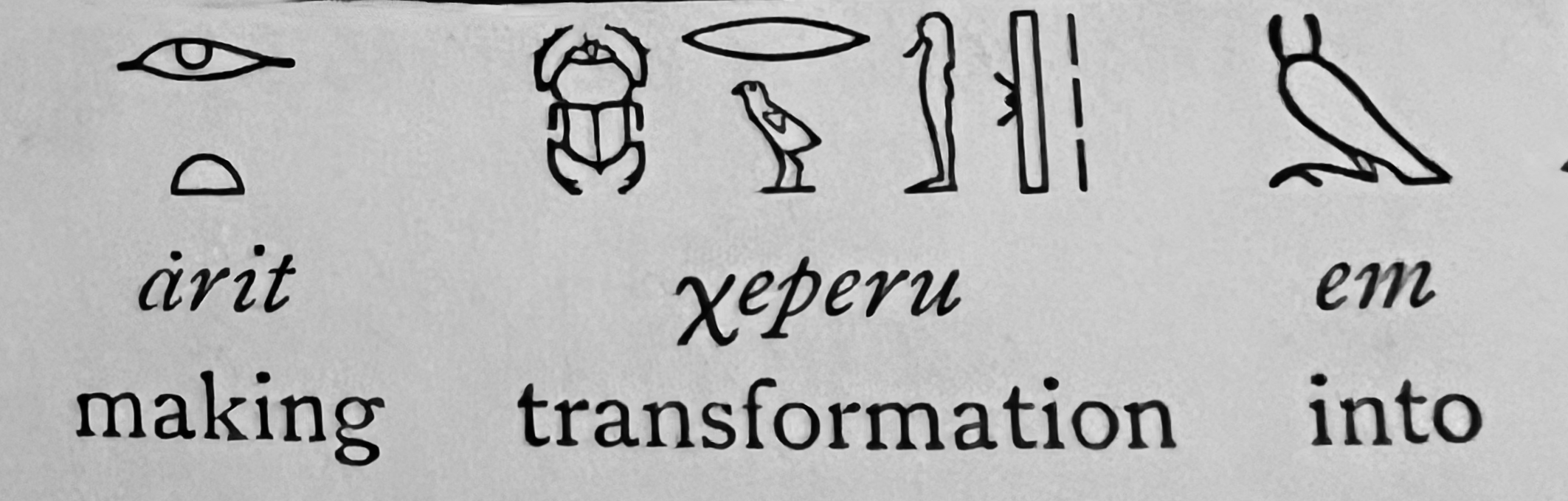
The Egyptian word is associated with transformation, creation, and renewal. The verb form can mean “coming into being,” “emerging as,” “becoming,” and “taking the form of.” The singular noun is kheper and the plural is kheperu. So, Kheperu can be translated as “transformations.”
In the Egyptian funerary literature, there are spells titled “Becoming” various things or Beings. Perhaps the most well-known one is “Becoming a Hawk of Gold.” The words translated as “becoming” are literally “making transformation into” a hawk of gold, as you see here: irit—which is the “doing” verb—and kheperu, transformations (but sometimes treated as a singular in Egyptian texts). Egyptologists often refer to these as “transformation spells.”
Significantly for our purposes, many of the Beings into which one may make transformation are Deities: Hathor, the Nile God, Horus, Anubis, and yes, of course, Isis.
Why use Kheperu?

For magic—the ancients needed magic for a good outcome after death, and we have numerous examples from the funerary literature. But Kheperu were also used by the living—in protection magic, as well as for the accomplishment of tasks, such as healing, gaining love, or for business or political success.
For ritual theater—theater was used in Egyptian religion, and it is possible that the actors (priests and priestesses) “transformed” into the Deities for the ritual performance.
For oracles—oracular temples had a built-in Kheper of the Deity: the sacred image of the Deity that had been magically enlivened by the ritual of the Opening of the Mouth. Archeological evidence suggests that some of these oracular statues had a bronze pipe that may have served as a speaking tube for giving oracles through the sacred image. We have no specific details about how the priests may have prepared for such an oracular audience. Assuming they were not complete frauds, I suggest that they were in the Kheper of the Deity.
For communion—just as some of us do today, the ancient Egyptians may have used Kheperu for deep communion with the Divine. The Book of the Dead says: “I will go into the Moon-God, so that he may speak to me, that the followers of the Gods may speak to me, that the Sun may speak to me, that the Sun-folk may speak to me.”
We can still use the technique of Kheperu for all these purposes. In magical spells, we can boost the power of our spell by taking on the Kheper of a Deity. (As Goddess of Magic, Isis is particularly appropriate for this.) In rituals, large and small, we may Become a Deity for the enactment of the particular rite. (Did you perhaps use the technique in Beltane rites this weekend?) And I highly, highly recommend that you use it for communion with Isis. We, too, can “go into Isis” so that She may speak to us and so that we may discover insights about Her and insights from Her.
How do we do Kheperu?
Fully “Becoming” Isis is not something you will necessarily achieve the first time you try it. It takes some practice. Usually, it takes both magical and ritual experience. So have patience. Yet, even attempting it will provide beneficial contact with the Goddess. The good news is that, when using the technique of Kheperu, we are not going for “full trance possession.” In full trance possession, the entranced person seems to vacate their body so that the inhabiting Being takes over completely. They usually do not remember what happened during the trance.
What we want to achieve is light trance possession. This means that we will be aware of what the Goddess is doing/thinking/transmitting, but we will also be aware of our human self that is absorbed in Her. Why? Because we want to remember the experience. We want to learn from it, from Her. And if we don’t remember anything of the experience, we can’t learn from the experience.
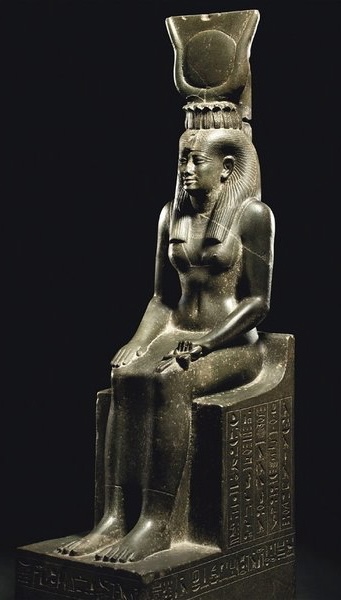
Using the technique of Kheperu means that we must cultivate a dual consciousness: both human and Divine. Our ordinary consciousness must be expanded in order to contact the energy of Isis. We must develop a state of mind that is larger than our subjective selves. We need to be able to identify with Isis to such an extent that our psyche becomes absorbed in the larger transpersonal power of the Goddess.
So how do we do this? In the time-honored ways of magic:
Ritual—we can use the names and epithets of Isis, tell or read Her myths to ourselves (pick the one that resonates with the purpose of your spell), and we can use Isis’ image to provide a framework; for example, by gazing at Her sacred image upon our altar. Chanting or singing Her name and epithets is also a powerful part of preparation.
Masks & costuming—for Isis, we might wear an Egyptian robe, headdress, or crown. For simplicity, we could choose to wear one or more pieces of jewelry that depict Her image.
Sacred gesture and posture—these can be as important as any other symbol, for they can be used to turn our ordinary human actions into archetypal, ritual gestures that are no longer just personal. When we do so, we expand ourselves, becoming larger than our ordinary selves, helping to create the expanded consciousness required.
If you want to see ancient Egyptian sacred postures and gestures, just look at Egyptian art. You’ll also find a number of sacred postures and gestures associated with Isis in Isis Magic. For instance, the “Wings of Isis” and the seated “Throne” posture. But we don’t just place our bodies in these positions; we also radiate energy through such postures and gestures.
Vizualization—while no ancient Egyptian text specifically says one should “see this in the mind’s eye,” there is no reason to assume such an instruction was not given orally, when used by living people. The reading of the spell itself may be used to build up the visualization. You can do this for yourself by reading any of your favorite invocations or ancient hymns of Isis, as you prepare to take on Her Kheper.
Psychic & energetic preparation—prepare yourself with purifications and consecrations. Ready your body, soul, and spirit with breathing exercises. The ancients may have done this, too; one text tells us: “I have come into You, having opened up my head and aroused my body.” (I absolutely adore the mental image of this text. How might you “open up your head” and “arouse your body” in preparation for ritual?)
So, that is our all-too-brief introduction to the technique of Kheperu. Next time, I’ll share the ritual we all did at Spirit Northwest to “Become Isis,” so you can try it for yourself.

