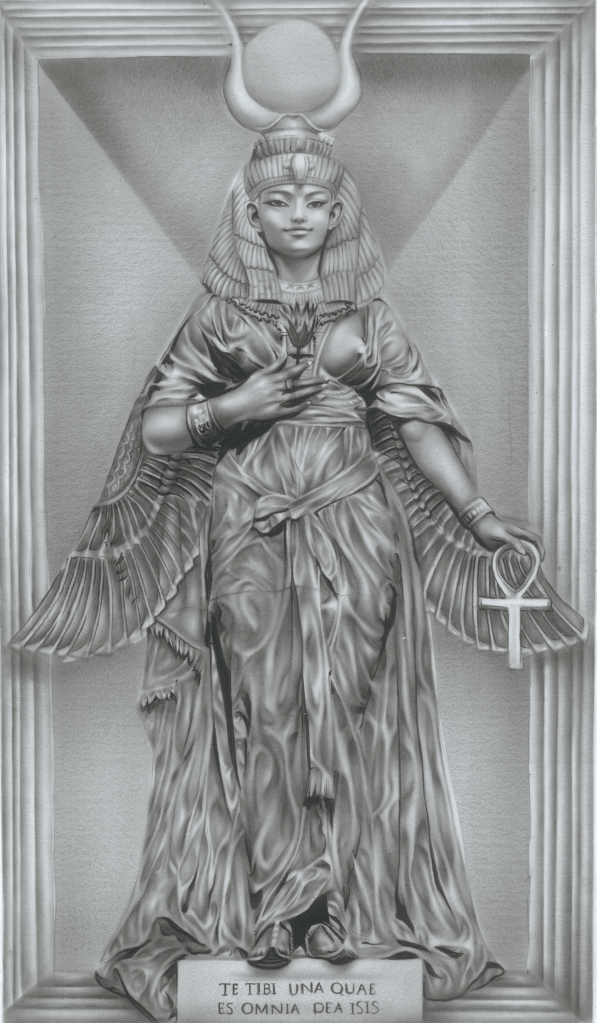
Deep, blue breath.
And now the work begins. Again. And, yes, it will take a long, long time.
Yet, this is something in which Our Lady Isis is well versed.
Starting again. Rebirth. Regeneration.
Indeed, resurrection and rebirth are among the most-crucial functions performed by Isis for Her murdered husband, Osiris. First, there is Osiris’ bodily resurrection. Isis collects the parts of His scattered body, rebuilding it by wrapping it in strips of linen and creating, according to late legend anyway, the first mummy.
The second resurrection the Goddess enacts is the resurrection of Osiris’ phallus in order to conceive an heir. With Her powerful magic, She imbues Osiris with sufficient life for a sexual coupling between the two Deities.
The result of this union, the child Horus, is a third resurrection. Osiris is reborn in His son. (This was also the formula of pharaonic succession. The living pharaoh is known as Horus the Son of Isis, while the dead pharaoh is identified with Osiris.)
Finally, Osiris Himself is reborn to a new life. While He is not bodily resurrected to regain His earthly throne, after begetting Horus, Osiris is resurrected in the Otherworld as Lord and Judge of the Dead. Osiris takes a new throne. He is changed as all things in the Goddess’ Great Round of Life are changed. He is reborn to a new existence.
Isis is also the Goddess of Initiation, a word that means “a beginning.” Isis initiated the Egyptian dead into their new existence. And, in later times, people could choose initiation into Her famous Mysteries.
Isis is the Goddess of Picking Your Ass Up and Trying Again. Time and time again, in Her myths, we see Our Goddess in devastating circumstances, but then, She rises. She carries on. The Greek priest Plutarch, who recorded his version of Isis and Osiris’ myth, tells us that Isis “consecrated at once a pattern of piety and an encouragement to men and women overtaken by similar misfortunes.” (On Isis and Osiris, 27)
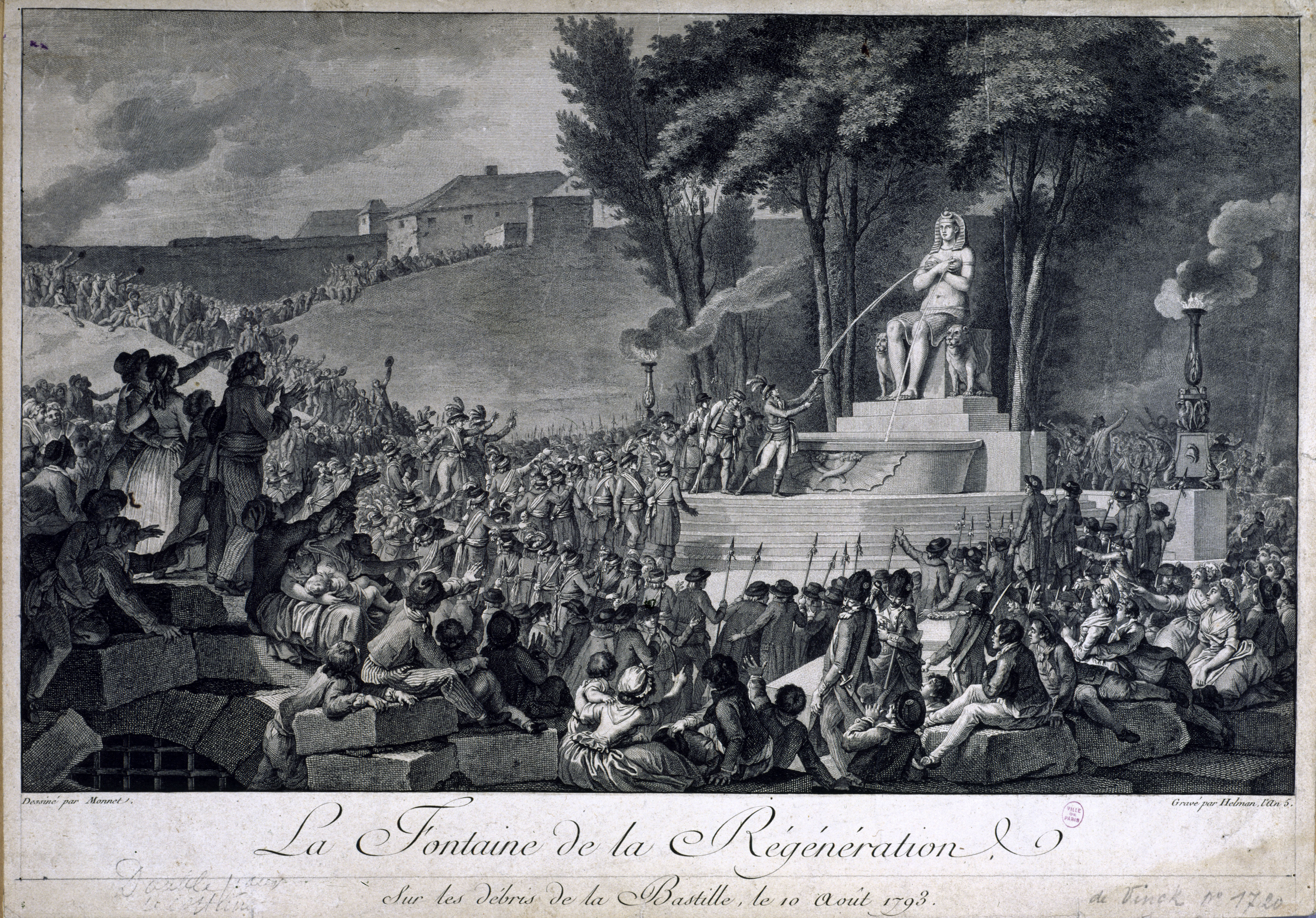
Isis & the Fountain of Regeneration
Isis served as just such an encouragement for the people of France after their own revolution.
(How’s that for a transition? Oof.)
I make this slightly wild leap because I’d like to tell you about an Isiac artwork that you may not have heard of. It was known as “La Fontaine de la Régénération,” and it was erected on the place where the hated Bastille prison of Paris had once stood.
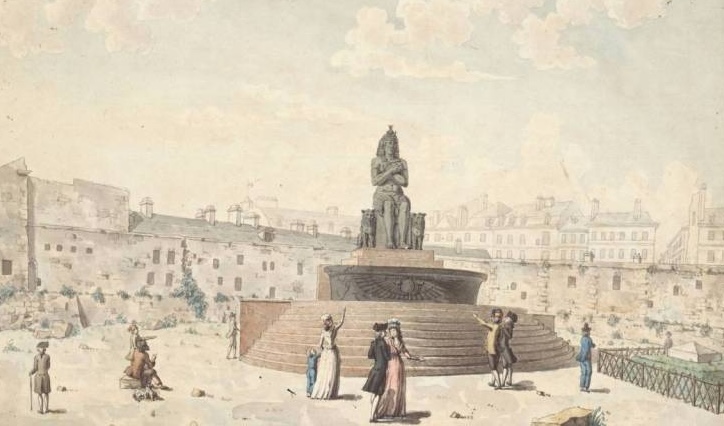
The storming of the Bastille by the people of Paris in 1789 marked the start of the French Revolution. The Fountain of Regeneration was erected four years later, in 1793, as part of the Festival of Unity & Indivisibility. The festival celebrated the one-year anniversary of the fall of the French monarchy.
Why Isis?
To tell the truth, Paris has always had a thing for Isis. If you’d like to learn more about that, and Isis’ French connection, go here.
In this particular case, the revolutionary leaders were trying to encourage people let go of the old monarchical ways and embrace the new revolutionary ideals. So, the painter Jacques-Louis David—who was kind of the art director of the Revolution (but then went on to be Napoleon’s portrait painter!)—envisioned a grand procession throughout Paris, beginning at the Fountain of Regeneration.
The Fountain was centered on an enormous image of Isis, symbolizing Nature and Regeneration, water pouring from Her breasts and caught in a basin below the Goddess’ feet. As was true of so many ancient Goddess images, Isis Regeneratrix of Paris was flanked by two seated lions.
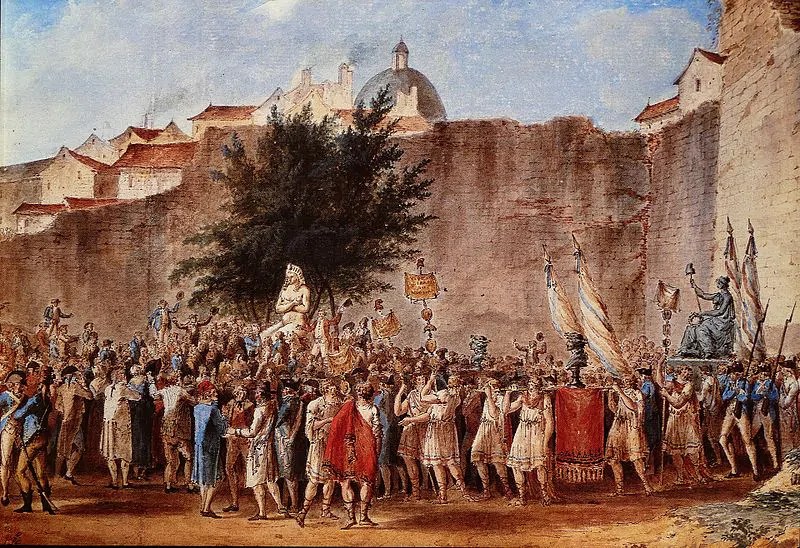
The Goddess’ eternal connections with nurturing and protective motherhood, as well as rebirth and regeneration, were perfect for what David wanted to express in his processional celebration.
Not only that, but Egyptomania was in full bloom in Europe at this time, and ancient Egypt was often idealized as a pure and primordial civilization. Associating the new revolution with the purity of this “original” civilization was one way that David sought to express the revolutionary ideals. Interestingly, these ideals included the rejection of the domination of the Church and Catholicism, so I guess a powerful, yet loving, Pagan Goddess was perfect.
Honestly, it was SOME festival
At dawn on the day of the festival, civic leaders, who came from across France to symbolically represent all the people, and thousands of citizens gathered at the Fountain and drank of the “Milk of Liberty”—that is, the water from the breasts of the Goddess.

Renewed by the Milk of Liberty, the procession moved on. It honored the women who had marched on Versailles as “the Heroines of October,” then it processed to the Place de la Révolution, where it was met by a giant statue of Liberty (the French have been into Statues of Liberty for a long time, you see), with the symbols of monarchy in a bonfire, burning at Her feet. Next the procession stopped at a huge statue of the French people portrayed as Hercules overcoming their oppressors. And finally it stopped at the Champ de Mars, at the Altar of the Fatherland (not the Motherland? what?), where the new French constitution was presented in a sacred cedar ark.
In all the illustrations and paintings we see here, the statue of Isis looks like it was made out of something substantial. But, it was actually made of papier mâché, plaster, and bronze paint. In other words, it was created just for the festival, and not intended to be permanent. Sadly, within a few years, the statue had deteriorated and was cleared away. Today, the Place de la Bastille no longer has a statue of Isis Regeneratrix, but features public areas and a large roundabout for vehicles.
Nevertheless, the statue of Isis must have made a big impression in its day. I was surprised to be able to find so many images of it available even today.
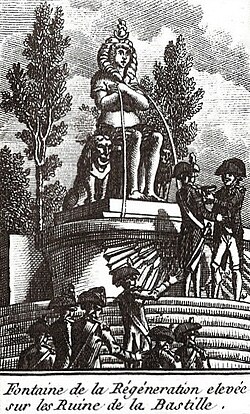
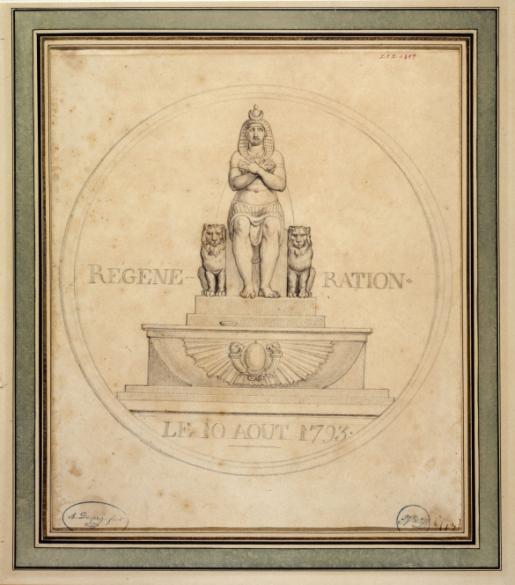
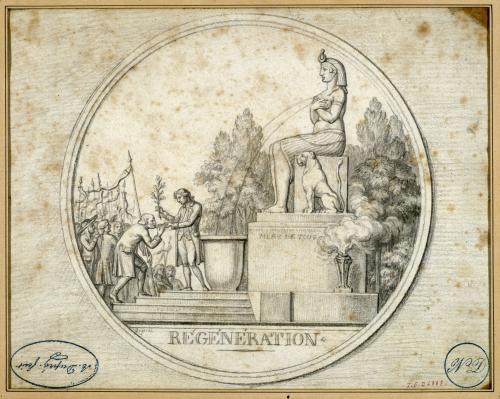
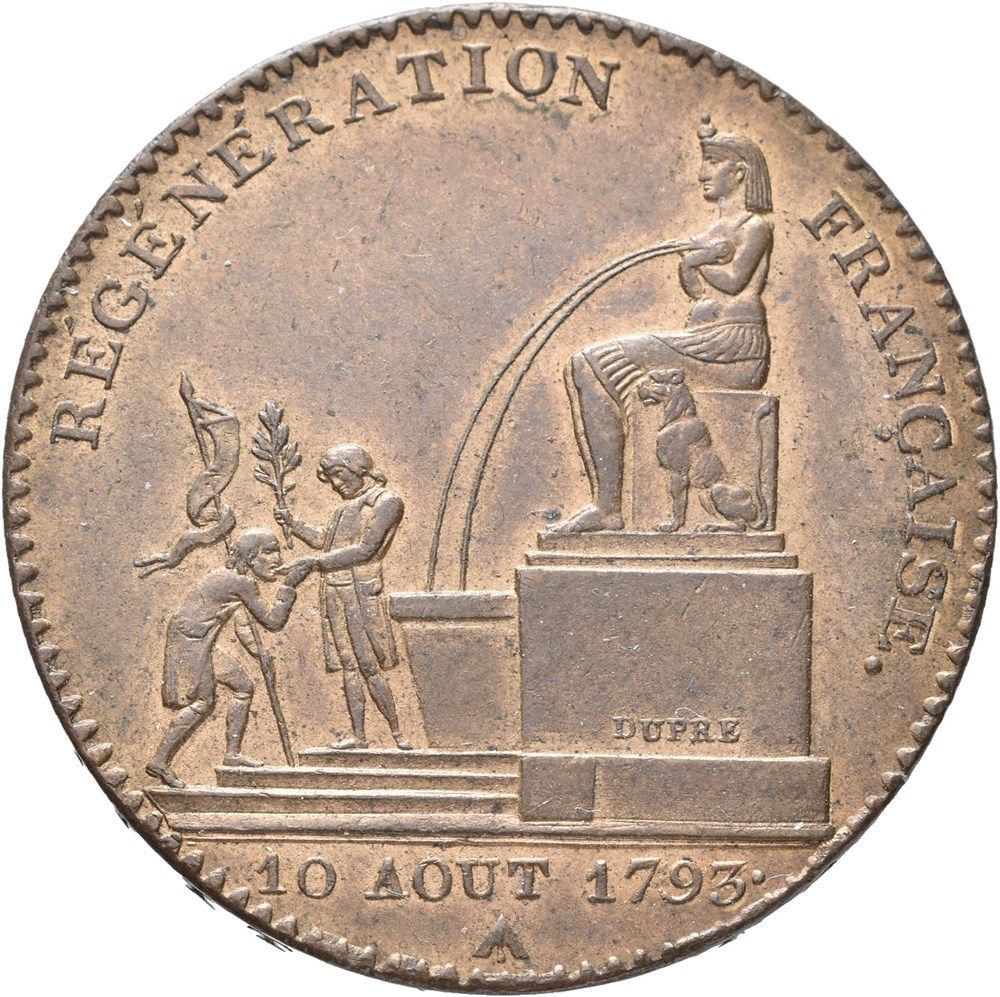

All this idealism was during the early period of the Revolution, before the bloody Reign of Terror, and the eventual overthrow of the revolutionary government by Napoleon.
Yet, the demise of the Revolution did not mean the end of Isis’ French connection. The connection remained so prevalent that Napoleon—who had developed his own rather severe case of Egyptomania following his Egyptian expedition in 1799—had Isis’ connection with Paris researched by his own scholar.
Apparently Napoleon was sufficiently convinced that there was an Egyptian-Parisian connection that he had a Parisian Coat of Arms designed that included an enthroned Isis on the prow of the “Ship of Paris” that was shown following the Goddess’ star.
May Isis, with Her regenerating power, and in Her Divine wisdom, guide us and our own leaders.


Thank you!! 🤍