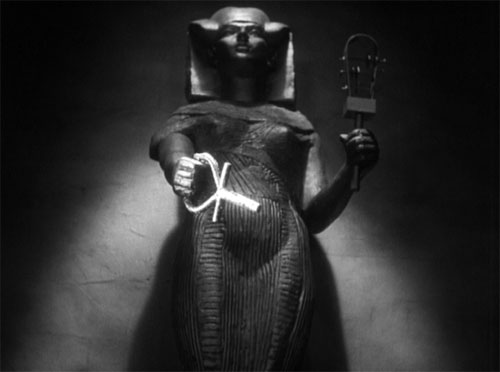
The awesome scene from “The Mummy” when the statue of Isis raises the ankh to save Her reincarnated priestess from a lovestruck but murderous mummy
Of all the emblems of ancient Egypt, the hieroglyphic symbol of the ankh is probably the most familiar. Many people still wear it as an amulet and know that, in Egyptian, ankh means life.

The ankh was extremely popular in ancient Egypt, too. Egyptians made ankh-shaped vessels, fan bases, sistra, unguent jars, jewelry, mirror cases—in addition to wearing the symbol itself as an amulet. Special bouquets of flowers, formed into the shapes of ankhs and simply called Ankhs, were given as offerings to Deities and as sustenance to the dead. The ankh was carved into temple walls and used to decorate furniture.
In later times, the Coptic Christian church used it as the crux ansata, the handled or “eyed” cross, because of its resemblance to the Christian cross.
Egyptologists still aren’t sure what the familiar oval-and-cross shape originally represented. Some believe it has sexual symbolism because some ankhs have what appears to be a female pubic triangle painted just beneath the cross bar. Others believe it represents a sandal strap. Still others see it as a type of magical knot or bow—similar to the Isis Knot or Tyet, which it closely resembles. Since Egyptian magic frequently employed knots, this idea is not at all far-fetched. Indeed, in some examples of the symbol, you can see what could be folds in the fabric or rope used to tie the knot.

Yet another interpretation combines the knot concept with an idea that may have some merit since it actually connects with the meaning of the symbol itself: life. In this interpretation, the ankh is an umbilical cord that has been looped and tied to a short stick (the cross bar) to create the ankh-shaped amulet. Thus the ankh represents the way Life flows from the Divine to the human in the same way that life flows from the mother to the child through the umbilical cord. There are numerous references to Isis “cutting the navel string” of the reborn Horus. And there is even a myth that Horus recovers the birth cord of His murdered father, Osiris, in order to bury it safely. In a tale about the birth of three kings, the children’s birth cords are cut off, wrapped, and preserved. Clearly, the birth cord had significance.

Yet the life symbolized by the ankh is more than simple daily existence. It is also the sacred and ever-renewing principle of Life. It is the Eternal Life with which the Goddesses and Gods imbue humanity. It is the Life that is renewed after death. In funerary art, Deities such as Anubis and Horus pour streams of ankhs over the deceased to symbolize this eternal, regenerating life that flows from the Divine. Goddesses and Gods hold the ankh to the nose of the deceased to revive her or him in the Otherworld.
While the ankh is rightfully a symbol of every Deity, it is also especially appropriate to Isis. On an earthly level, Isis is the Great Divine Mother, the generatrix of all life on Earth. Isis is intimately connected with the fields that bring forth food, the waters that nourish and regenerate the land, and the life-giving air that fills our lungs.
Isis is a Green Goddess of Life, daughter of Earth and Sky. The Coffin Texts call Her She of Vegetation and Mistress of Herbage Who Makes the Two Lands Green. She is a Water Goddess for Her yearly tears for Osiris caused the Nile to overflow its banks, vivifying the land. She is the Queen of the Sea and the Lady Who brings rain. As a Bird Goddess, Isis is Mistress of the Skies and a Lady of Air.

On a spiritual level, Isis gives the gift of renewed life after death. Beating Her magical wings, the Goddess fans air—and ankh—into the nose and lungs of Her beloved Osiris. It is Isis’ vital breath that fills the nemset jars with which the deceased is dried after a purifying bath. And it is Isis Who brings the spiritual water that helps regenerate the dead.
As She is the Lady of Life, Isis is the Lady of Life Everlasting. She is the Green Goddess of life on Earth and She is the Divine Mother of each of us Who cuts our navel-string when we are transformed and reborn into Eternal Life.
 Isiopolis
Hail Isis!
It also reminds me of the symbol of venus. And if you think of Isis and aphrodite, being the symbol of life and renewal and birth and rebirth it fits right in with what you’re saying. Love you! ❤️
They seriously don’t know what it means? The loop at the top is the uterus, the bar under it is the cervix, and the line under both is the birth canal. It’s obvious.
Greetings Dear Isidora
I’m from Iran. I’m going to be an Isian. I’m doing a few things I’ve found online on a daily basis. Since we are under sanctions, I can’t buy your books in print but I can buy ebooks. Would you please publish the two books electronically?
Until then would you please
May Isis be with you and protect you
Hello, Fariftar! I’m afraid there aren’t any current plans to publish electronically. But there are many good online resources. The most important thing is your connection to Her. As you develop that relationship, She will guide you.
Under Her Wings,
Isidora
Greetings! I will hold you in my heart and thoughts! May the Great Goddess bless you, your loved ones and family! Please stay connected here!
hey hey question here
I wrote a paper about Isis in Rome. I wrote it a while back and lost most of the papers I had downloaded. I am struggling to find reliable sources on whether Isis held the ankh or the tyet (or perhaps and more likely both). I need decisive evidence (as decisive as can be what with it being couple thousands years ago). Meaning testimonies like Apuleius’ or Plutarch’s, hell even Dio’s. Peer reviewed paper and the likes.
If you know of anything such as that I’d love a name a link anything really.
Thank you in advance.
The tyet or ‘Knot of Isis’ wasn’t generally a hand-held symbol like the ankh often was. It is the ankh, held by the top loop, that you see almost exclusively in representations of both Goddesses and Gods, especially enthroned ones where it is held in one hand and placed on the lap. So Isis, like the others, holds the ankh. (You can confirm this by looking at the many images of Egyptian Deities available online.)
The tyet is usually worn as an amulet around the neck or secured to clothing or wrapped within the mummy wrappings. You will also see the tyet AS a Goddess: the tyet knot is the Goddess’ body, but She also has a human head and limbs. There are images like this for Nuet, Nephthys, Hathor, and Amentet. I don’t recall seeing an Isis, but I wouldn’t be surprised.
The article here https://www.touregypt.net/featurestories/tyet.htm is taken almost directly from Wilkinson’s “Reading Egyptian Art” book and is reliable. By the New Kingdom, the tyet was often represented with the djed pillar and so these two became symbols of Isis and Osiris respectively. By the time of the authors you mention, the Isis Knot most familiar to them as non-Egyptians would have been the knot tied into the front of Isis’ robes. But that had its start in Egypt, too. You can learn about how that came to be here: https://isiopolis.com/2019/11/16/what-is-the-tyet-or-knot-of-isis/. So, to answer your question–to my knowledge–neither Isis nor any other Egyptian Deity carried the tyet in Their hand as They did the ankh. But by the Hellenistic and later periods, the way Isis would have had this important symbol of protection with Her was by having the tyet knot tied into Her clothing.
I’m afraid there isn’t much in-depth research on the tyet tbh. Generally, what’s available is a paragraph or two in books about Egyptian amulets or symbols. Wilkinson’s work gives a whole page 🙂 Good luck in your search. Let me know if you find anything interesting.