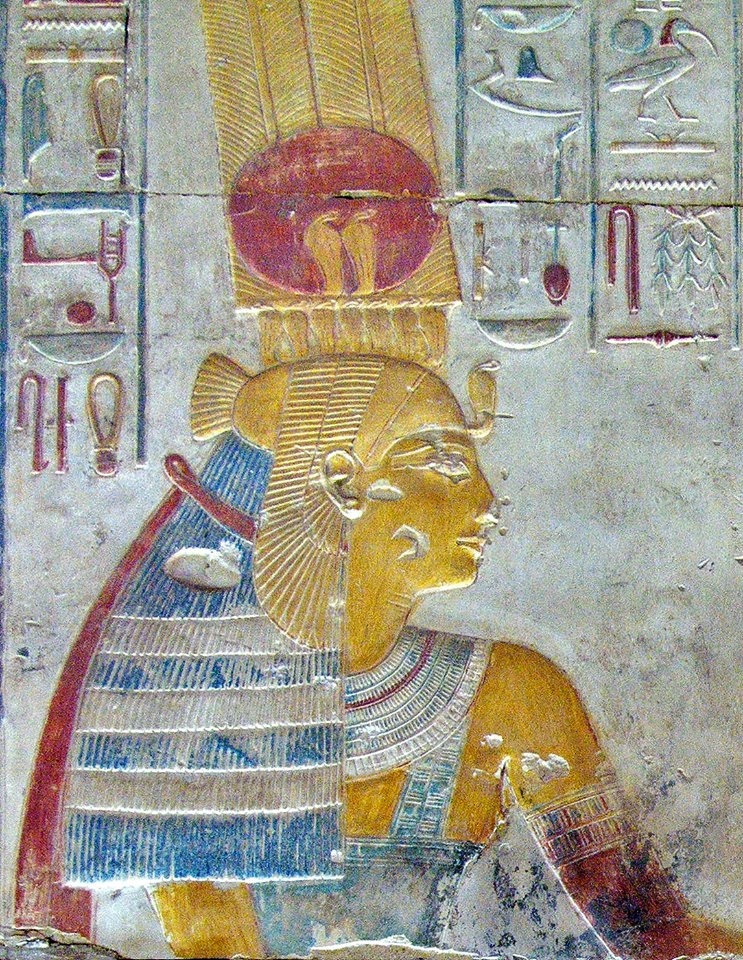
Oooohh.
I have a new (to me, at least) book of the Egyptian afterlife for you. It’s the Book of Transformations.
Sounds intriguing? I thought so, too.
Here’s some background: We have just three examples of these Ptolemaic-period books. Rather than being a wide variety of spells for the afterlife, such as those contained in the various Books of the Dead, the Books of Transformations are devoted to the post-mortum transformations of the Ba. In other words, they are spells for shapeshifting.
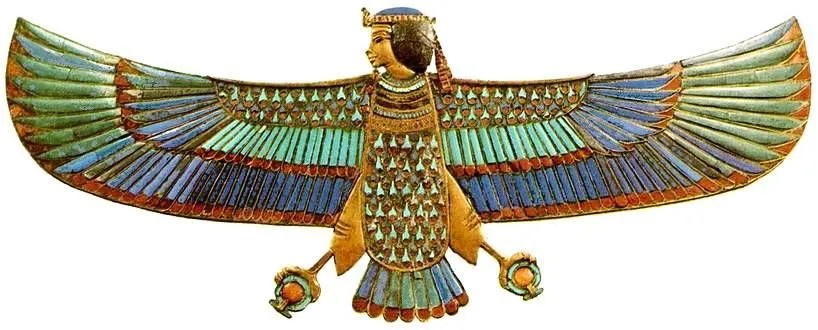
One of the most important functions of the Ba (often translated as “soul,” but it’s a LOT more than that) is to enable the deceased person to change into a variety of different forms. In fact, the Ba can take any form that it wishes. It can be a hawk of gold, a lotus, even a Deity. This gives the Ba-form of the deceased incredible freedom. The deceased can be anything they want to be and anywhere they want to be—heaven, earth, or underworld.
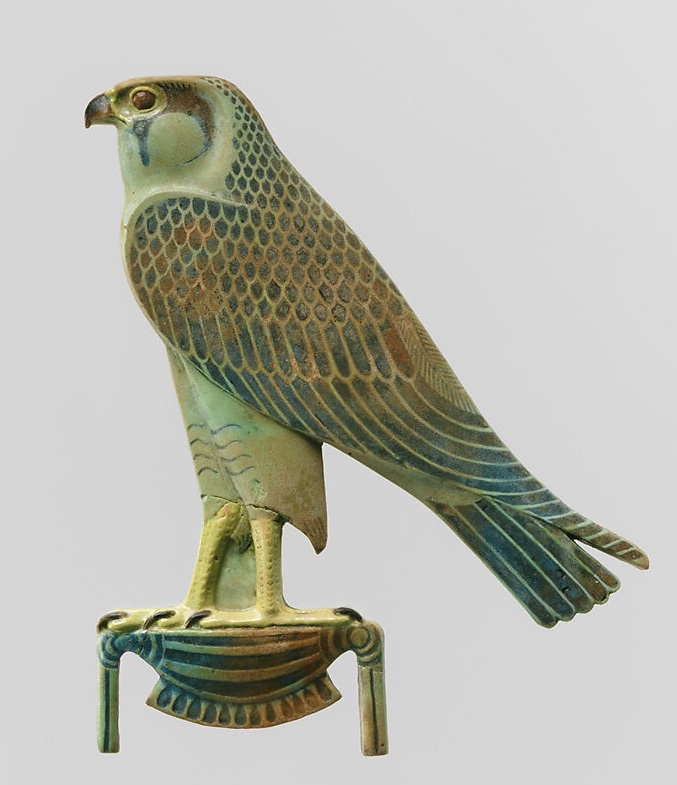
The shapeshifts detailed in the Books of Transformations seem to particularly focus on the non-human forms, like becoming a serpent or a hawk. And each of these forms is allied with one of the Deities. For example, if the Ba transforms into a falcon, it is associated with Horus—and Horus rejoices in the transformation.
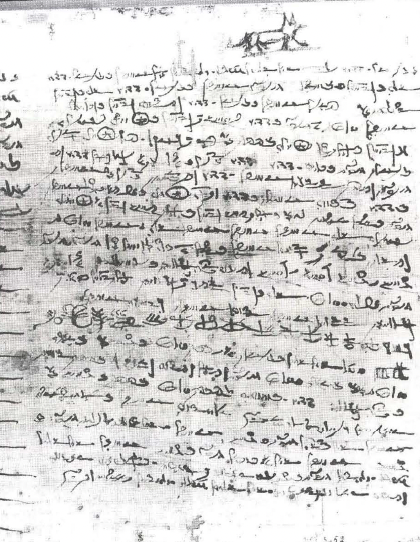
One of these three precious examples of Books of Transformations includes a great deal of emphasis on our Goddess Isis. That is, as you have already guessed, the book we’ll be talking about today. It is also the earliest-known funerary text written in Demotic, a late, simplified script writing that evolved from the hieroglyphs.
The book in which Isis is prominent was made for a man named Imuthes. He was a priest of Amun, Imhotep, and Hathor. He was not a priest of Isis, as far as we know. Yet because Isis, Lady of Bas, Lady of Souls, is so important to the Ba as well as to the resurrection of the dead, She is the first Deity that the Ba of Imuthes addresses in the important magical Book of Transformations that was buried with him.
On the other hand, perhaps the emphasis on Isis was because Imuthes was “a magician pre-eminent in his craft,” and the Goddess of Magic was especially important to him, particularly after death. Imuthes was from Thebes and he died at age 78, some time between 57 BCE and 56 BCE.
The purpose of the Book of Transformations interred with Imuthes was “causing the Ba to breathe and go forth from the underworld upon the land of Re in any form which he desires in order to serve any God of any temple and worship Him [the Deity of the temple] to His wish by the Osiris of Imuthes, the son of Panekhates, whose mother is Senobastis.” And it is specifically Isis Who causes his Ba to breathe. The text tells Imuthes:
The Lady of the Uraeus [Isis] will favor you, the Mistress of the Holy Underworld, the Lady of the Portal, the Mistress with Mercy in Her Heart, the Sister of the God, She Who Loves Her Brother [Osiris]. She of Answer responds to your [Imuthes’] utterance. Isis the Great, the God’s Mother, She will cause your Ba to be made to breathe so that you live every day. (My capitalization)
Imuthes’ Book of Transformations
Imuthes’ book also had some illustrations or vignettes. The one shown above, unfortunately, doesn’t have the Isiac illustration. But here’s a description of it:
Painted above the text with Isis’ titles that I just quoted, there is an illustration of the headdress of Isis—the Horns & Disk, with uraeus serpent (She is called the “Lady of the Uraeus” throughout this text). The headdress is placed above a drawing of a lotus. This image tells us, in a kind of rebus-form, that Isis is in charge of, or “over,” the process of rejuvenation, symbolized by the lotus, in which Imuthes is engaged. Imuthes prays to Isis:
Come, come into my body. Come, come into my heart. Come to me, Mistress. I am a willing servant. My heart will be jubilant, serving You everyday. May You allow me to serve the Divine Ba [Osiris] in the Great Secret Shrine of Faience, Osiris Dwelling Within Everything… (My capitalization)
Imuthes’ Book of Transformations
I particularly love that text and think I my be using it in my invocations of Her. Then next, the text praises Osiris, Lord of the Underworld. Following that, Imuthes text says that Isis, the Lady of the Uraeus, has given him a command that he should also be in the service of Osiris and that he will obey Her command so that his Ba:
will be made to breathe, his Ba will be made to shine, his Ba will be made to endure, his Ba will be made jubilant, his Ba will be made Divine, his Ba will be made strong, his Ba will be made mighty, his Ba will be made to remain, and his Ba will be made to rejoice, so You [Osiris] will live and Your Ba will live, You will be mighty and Your heart will be mighty. Your Ba will unite with life, seeing the sun disc. (My capitalization)
Imuthes’ Book of Transformations
Isis will make Imuthes’ Ba breathe and live, so that Osiris’ Ba can also breathe and live. Then Isis also speaks to Osiris, saying “Come in peace, be praised in peace! Your Ba is in a state of life, so that You live for ever and ever.”
Then come the six different transformations included in this specific book. (They vary in the three copies we have.)
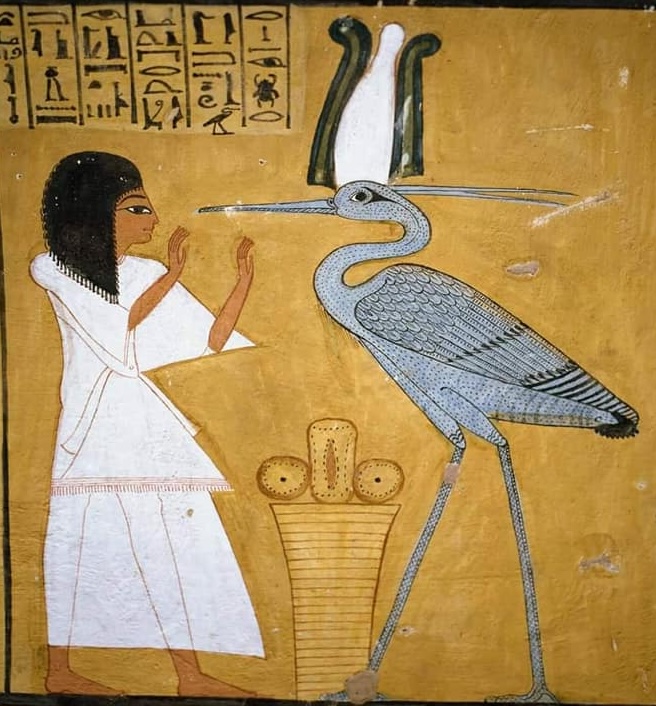
Imuthes’ Ba takes the Kheper or Form of a falcon, associated with Horus; he takes the form of an ibis, associated with Thoth; a phoenix, associated with Re-Harakhti; a Ba, associated with movement and with the mummy of Imuthes; a dog, associated with Anubis; and a serpent, associated with Atum and creation as well as re-creation.
The thing that struck me was how completely joyful each of these transformations is expected to be for the Ba of Imuthes. His Ba exults and the Deities exult with him. His Ba is made “jubilant,” as well as effective, divine, happy, triumphant, and peaceful. Throughout the text, he also refers back to Isis, the Lady of the Uraeus. He says that he will be breathing “in the form of an ibis,” being jubilant and rejoicing, and will be “serving the Lady of the Uraeus.” She, too, will be “in a state of joy” and She will “act in accordance with every utterance of his.” In other words, because of Isis’ joy in giving breath to the Ba of Imuthes, She will accomplish for him all the wonderful, magical things that are recorded in his Book of Transformations.
The last things I’d like to share with you are a few of the things that simply caught my interest from some of the transformations of Imuthes’ Ba.
As a falcon, Horus will be triumphant for Imuthes, both the sky and the earth will flourish, and Horus exults. As an ibis, his Ba “comes to the Venerable Heart,” that is Thoth as the Heart of Re. And because Thoth is Lord of Magic, his Ba will be “magnified” and “rendered effective (akh)” as an ibis. As a phoenix, Imuthes’ Ba will be content, and “continually manifest,” and will also be in the presence of the great Phoenix, or Benu, a form of Osiris.

As a Ba, Imuthes is concerned with the easy movement of his Ba and with its return to his mummy each night. His Ba is asked to “breathe upon his head and upon every limb of his.” As a dog, with Anubis, Imuthes’ Ba will be “enchanted.” As a serpent, the Ba of Imuthes is in youthful vigor and is revivified and rejuvenated each day.
The last part of the text is a purification and censing. Imuthes’ Ba is given water to drink. But it is not just any water. It is the water of the Primordial Nun, the waters of All Potential, the Waters of Creation. Nun is hailed and said to come rejoicing to provide this sacred water. Then the text goes on to remind the Deities that Imuthes comes forth justified, having passed the Judgment of Osiris, and is “in a state of perfection forever.” And finally, Imuthes is like the breeze:
Coming to the breeze in the course of every single day by the Osiris of Imuthes, whom Senobastis bore. He will be manifest and go forth with the breeze. The Doors of the Underworld will open for him every day. [He] will come and go in peace. The Doors [of] the Silent Land will open for him in jubilation forever. The sweet breeze of the north wind will appear for him daily. The Ba will go forth, the Ba will be manifest. Life will be decreed for him in a state of happiness. (My capitalization)
Imuthes’ Book of Transformations
This seems both a powerful and a pleasant life-after-death to me. What’s your afterlife like?
 Isiopolis