Last week, we noted that in one of the Oxyrhynchus papyri, there is a hymn to Isis that lists some of the many places throughout the Mediterranean that She is worshipped, and by what name each of those places invokes Her. Among the Amazons, we learn that Isis is called “Warlike.”
We looked at some of what the ancient Greeks thought about the Amazons. We also saw evidence of some possibly very real Amazons. This week, let’s find out where and how our Goddess Isis comes into this Amazonian story.
The short answer lies in Isis’ identity as the Goddess of the Ten Thousand Names. But, of course, we’ll look into a somewhat longer answer.
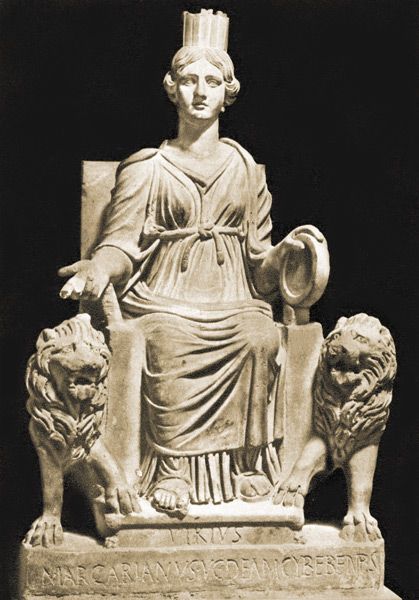
We know a little about the religion of the Amazons—at least what some Greeks said about it. Appollonius of Rhodes, ancient Greek poet, scholar, and librarian at the Library of Alexandria, says that the Amazons honored a large, black stone placed on an open-air altar. As it turns out, the Great Mother Kybele was worshipped in just such an image. And Diodorus Siculus says that the Amazons worshipped the Mother of the Gods (often Kybele or Rhea) and consecrated the island of Samothrace to Her. It would certainly make sense that the Great Mother would be the Deity worshipped by this woman-centered society—even if Ares (see last week’s post) was their sperm-donor dad. The worship of the Great Mother was extremely prominent in Asia Minor. And the most well known of these ancient Great Mothers is Artemis of Ephesus.
The rites of the Great Mother, particularly as Rhea and Kybele, were characterized by what we might call Dionysian ecstasy. Indeed, in Dionysos’ myth, it is the Great Mother Rhea Who taught Dionysos His own rites. Imagine ecstatic dance to pounding drums, tinkling cymbals, and piercing flutes. Of course the Romans were particularly aghast at the idea that, in this ecstasy, men who wished to serve as Her priests, would castrate themselves, becoming Her Gallus (sing.) or Galli (pl.). The Great Mothers also had a circle of semi-divine male warriors who would attend Her, known as Kuretes or Korybantes. They were often considered as culture heroes, as well as being known for their boisterous and ecstatic war dances.
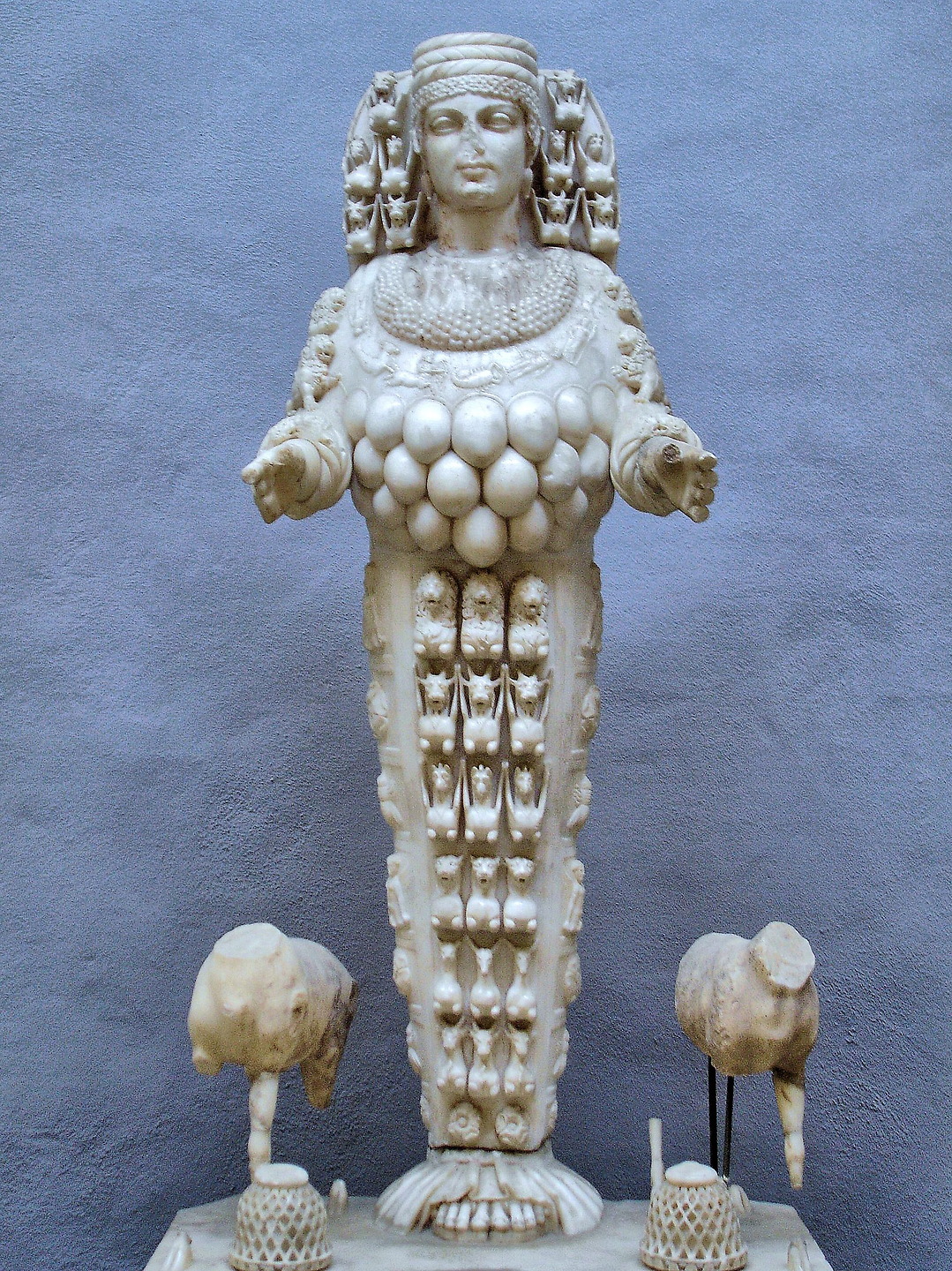
There are many more Goddesses Who share the general characteristics of the Asia Minor Great Mother: the Lydian Mother Goddess, Kybebe, Kretan Rhea, Hekate of Samothrace and Lagina, Bendis of Thrace and Lemnos, the Cappadocian Mâ, Britomartis or Dictynna of Krete, the Syrian Goddess of Hierapolis, and many Artemis-identified Goddesses, including, of course, the Ephesian Artemis. Diodorus Siculus tells us that the Amazons sacrificed to Artemis Tauropolos (“Bull-Driving Artemis”).
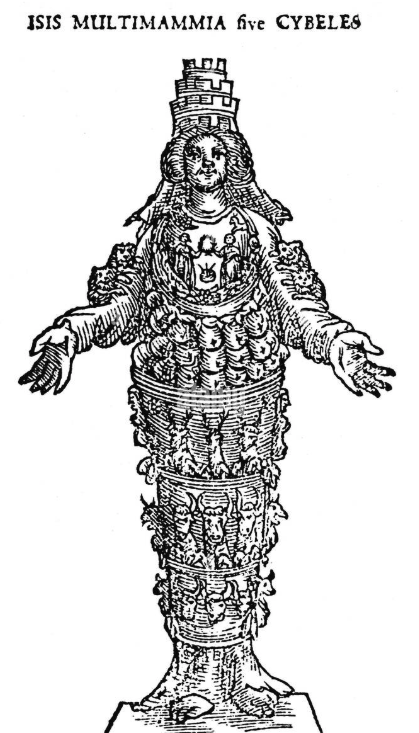
Isis of the Ten Thousand Names was syncretized with all these Goddesses, but perhaps especially with the many different forms of Artemis. Indeed, Isis and Artemis were among THE most syncretized Goddesses in the Mediterranean.
Legend had it that the Amazons were the founders of the shrine of Ephesian Artemis. The poet Pindar says that they established it on their way to make war on Athens when it was ruled by Theseus. Other writers, like Pausanias, say that they didn’t found it, but that they began the custom of seeking asylum at the altar of the Great Mother. The seeking of asylum in the altar of the Great Mother was a long-standing tradition in Ephesus.
Ephesus was also home to an important Temple of Isis. Ephesus always had a large Egyptian population. The fact that Isis’ pink-granite temple stood in the middle of the State Agora tells you how important She was there.
The temple was built in Hellenistic times when Ephesus had a strong trade relationship with Alexandria. The temple was destroyed under the Roman emperor Augustus, due to his hatred of all things Egyptian as a result of his war against Antony and Cleopatra. Some of the Isis temple’s building material was reused in the Fountain of Pollio, which celebrated the architect of the aqueduct which carried water to Ephesus.
Isis was also to be found further north, deeper into Amazon territory. We find Her around the northern Black Sea, in what was known as the Bosporan Kingdom. Today, this land is part of Ukraine, Russia, and the disputed Crimea. Ptolemaic Egypt had ties to the Bosporans, both being important wheat exporters. There were numerous Greek colonies in this area, too. With Isis so prominent in Hellenic lands, the combination of Greek colonies and Egyptian contact made it perhaps inevitable that Isis should also be found there. It seems that the myth of Isis-Io was particularly important there, for the name “Bosporus” was supposed to come from this myth. In the form of a cow (bous, in Greek), Isis-Io crossed over (poros is a ford or crossing) what is today called the Straits of Kerch, the land that connects the Crimea and Russia. Its ancient name was thus Bous-poros, though this etymology is dubious.
All that geography gets us to where we need to be to connect Isis-Io with the Amazons. In Aeschylus’ play Prometheus Unbound, Prometheus advises Io in Her wanderings. As you recall, both Io and Prometheus are tormented by Their encounters with Zeus and, in Io’s case, with its consequences from Hera.
In the play, Prometheus advises wandering Io to go east from where He is (on a crag somewhere around the northern Black Sea), and to cross the Caucasus Mountains. There She will reach the Amazons who will gladly guide Her on Her way. Prometheus also notes that the Amazons will eventually inhabit Themiscyra on the Thermodon river (south side of the Black Sea; so these are indeed intended to be the Amazons we’re talking about). Prometheus reiterates that the Bosporus will be called after Io’s crossing there. As we know, Io will end Her wanderings in Egypt, where She will be connected with, and worshipped as, Isis.
In a house overlooking the sea in the Bosporan kingdom, there is a well-known wall painting that includes a trireme ship, with the name “Isis” carved on the ship’s prow. There is also a lot of graffiti on the home’s walls, including Bosporan royal names, and the name of Aphrodite. As a result, the place is sometimes considered to be a shrine of Aphrodite, with Whom, of course, Isis is also assimilated.
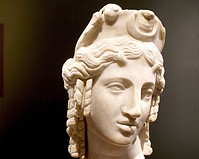
Researchers are not entirely clear about the why the Isis ship is depicted. But it seems to me that it might be connected with the Isian Ploiaphesia, or Navigium Isidis, which would mean there would have been a significant Isis community in Bosporus—significant enough to conduct this important festival of the Goddess.
So now we have Isis, and Isis-Io, in—broadly—Amazon territory. We know the Amazons worshipped a Great Mother, as Isis is. We know that many of the Great Goddesses of Asia Minor and further east, such as Kybele, Rhea, and Artemis, were assimilated with Isis. We know that Aeschylus considered that the Amazons would be friendly to a Wandering Goddess, such as Isis-Io. So, now we must address Isis’ “warlike” characteristics, for among the Amazons, we know She is called Warlike.
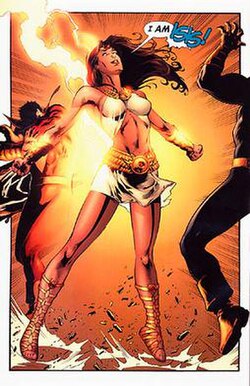
Isis is one of Egypt’s Great Protectress Goddesses. She protects Osiris and the dead. But She also protects Egypt itself. In some of the Isis aretalogies She declares, “I am the Mistress of War.” The Oxyrhynchus papyrus also calls Her the Lady of War and Rule and that She “easily destroyest tyrants by trusty counels.” At Her Philae temple, on one of the Great Pylons, Cleopatra speaks to her brother Ptolemy saying, “Brother, trust in Isis. She is more effective than millions of soldiers.” A Philae hymn calls Her mightier than the mighty, stronger than the strong, as well as “Great of Massacre Against Her Enemies.” In Her fierce form, She is often syncretized with Sakhmet and shares Her Fiery Nature. Isis is also the great Uraeus Serpent, the Flaming Eye of Re, Who protects the Deities and humankind. So yeah, Warlike.
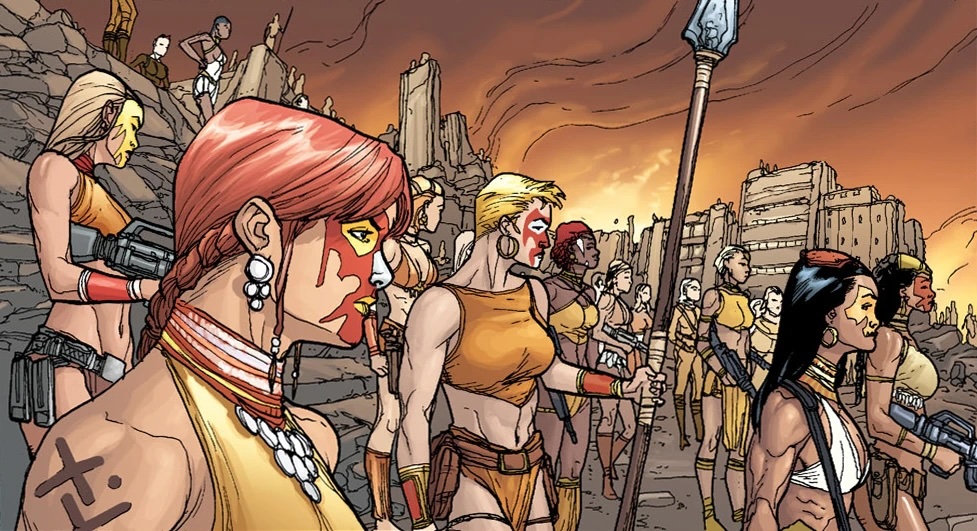
Isis is connected with the Amazons in modern mythology, too—by which I mean graphic novels/comics. In the DC comic universe, Isis is the primary Goddess of the Amazons of Bana-Mighdall.
According to the DC lore, the original Amazons were created by Olympian Goddesses to teach humanity righteousness and the equality of the sexes. The Amazons established the city-state of Themiscyra—Wonder Woman’s home—in Greece. Tales of Amazonian power and courage spread across Greece.
Through trickery, however, the Amazons were enslaved by men. Eventually winning their freedom once more, the Amazons broke into two factions: those who stayed loyal to the Olympian Goddesses and withdrew to Themiscyra, and those who did not. The splinter group denounced the Olympians and settled in Egypt, worshipping Isis, and becoming even more fierce. Isis protects their city with a perpetual sandstorm that hides it from the world.
In later episodes, the Bana-Mighdall Amazons fight against Wonder Woman and the Themiscyran Amazons, but eventually are reintegrated into Themiscyran society.
So there we are, dear Isiacs. Isis does have some Amazon connections, as roundabout as they may be. And yeah, I am quite sure we need that Amazon energy, right the holy-heck now.
 Isiopolis
People often overlook Isis’s warrior side, even though it’s one of her most important aspects. In the Pyramid Texts, among the tools whose name the deceased must know is the knife/sword of Isis (the words for sword and knife are the same in ancient Egyptian They only used short swords) And she gave it to Horus, her son, meaning that Horus did not inherited his father’s sword, but his mother’s sword.
It is also mentioned that the gods fought and killed the serpent Apep every day using this knife in the Book of Amduat. And also in its image as the Eye of Ra, the serpent that breathes fire
And in the temple of Edfu, she alone could restrain Seth when Ra commanded her to do so, for Seth’s power was actually almost equal to that of Horus the Elder (Osiris) and Horus the Lesser, while she was stronger than him.
In the Great Hymn to Osiris of the New Kingdom, she is said to be the one who fights the rebels.
So Isis was indeed a warrior goddess; not a brutal force like Seth, but a fighter for justice and its protector.
People often overlook Isis’s warrior side, even though it’s one of her most important aspects. In the Pyramid Texts, among the tools whose name the deceased must know is the knife/sword of Isis (the words for sword and knife are the same in ancient Egyptian They only used short swords) And she gave it to Horus, her son, meaning that Horus did not inherited his father’s sword, but his mother’s sword.It is also mentioned that the gods fought and killed the serpent Apep every day using this knife in the Book of Amduat. And also in its image as the Eye of Ra, the serpent that breathes fire And in the temple of Edfu, she alone could restrain Seth when Ra commanded her to do so, for Seth’s power was actually almost equal to that of Horus the Elder (Osiris) and Horus the Lesser, while she was stronger than him. In the Great Hymn to Osiris of the New Kingdom, she is said to be the one who fights the rebels. So Isis was indeed a warrior goddess; not a brutal force like Seth, but a fighter for justice and its protector.
Hail Isis!
Thank you for the wonderful article! Happy International Women’s Day! :)