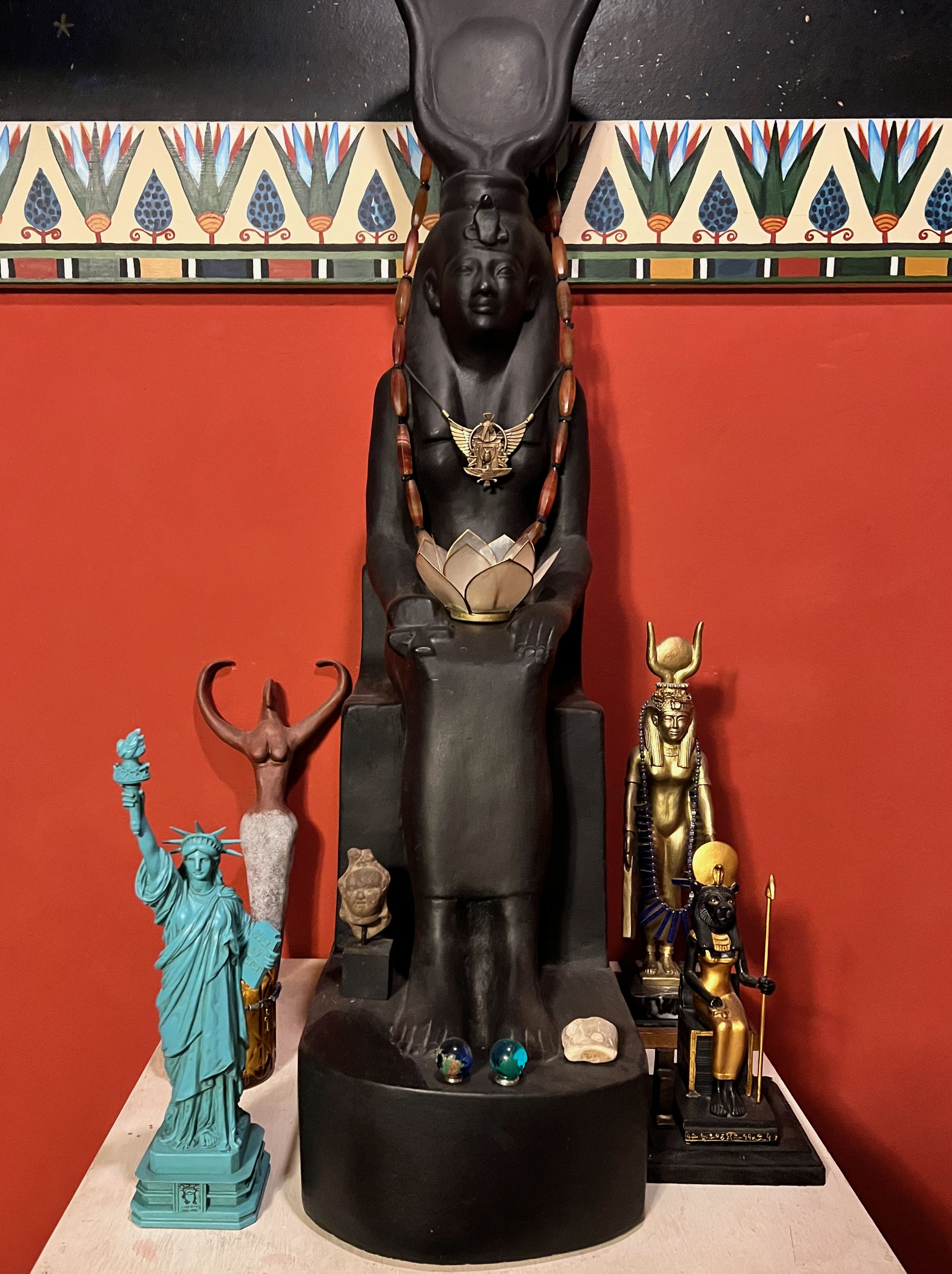
At the last full moon, I vowed to meditate or make offering to Her every day for a full moon cycle. My practice had fallen off a bit and I was wanting to re-energize myself. So far, so good.
For the offering part, I’ve been using the invocation offerings in Offering to Isis (handy, that!). So I wanted to share with you one of the offerings I chose to ask for Her help at this terrible time in the history of my country. I also added a sacred image of Lady Liberty to my altar, as you can see here.
And I’ve finally memorized the offering ritual. It’s always SO much nicer when you can do it from memory; that allows you to improvise, if you like, too, which I most certainly do.
So, here’s the background information about the offering of the Unknotted Cord, followed by the invocation offering. And here’s more about offering in general, as well as invocation offerings.
Unknotted Cord
One of Isis’ most important symbols is the Knot of Isis, a knotted cord or cloth. It is an amulet of the protection of the Goddess. Knot magic, such as that represented by the Knot of Isis, was common in ancient Egypt. The Pyramid Texts tell us that Isis and Nephthys work protective magic on Osiris “with knotted cords.” References to knot magic abound, not only in the funerary literature, but also in the Graeco-Egyptian magical papyri, a valuable collection of ancient magical rites.

The power of the magical knot is in its ability to both unite and “surround” things. The tied knot is a symbol of the coming together of two things in perfect wholeness, a condition that promotes a positive outcome. A passage in the Coffin Texts says that when the hair of Isis is knotted to the hair of Nephthys, the Two River Banks (the land of the living and the land of the dead) are united. Because of this perfect wholeness, the deceased prays to be united in the Two Sisters forever, sharing in Their perfection.
Tying a knot could also refer to sexuality; the perfect coming together of female and male in an act of creation. Furthermore, because the two ends of the cord used in tying a magical knot symbolically go all the way around something, they were thought of as “surrounding” that thing. Knot magic could thus be used to “surround” or “bind” an enemy. (And here’s some info on binding magic and more for these hard times. )
This was a common motif in all periods of ancient Egyptian history. Funerary and religious texts depicted the enemies of the Deities bound and subdued. Human enemies of Egypt were frequently shown with their arms bound helplessly behind their backs. Just as a knot can surround, it can also encircle; and to encircle was to enchant—the ancient Egyptian words are the same. When the two ends of a cord were tied around a person, they were both encircled and enchanted.
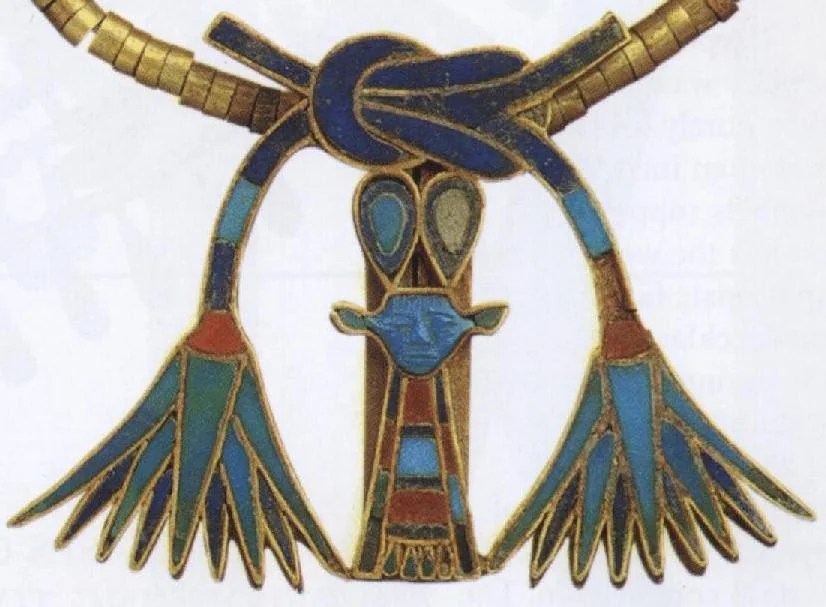
So the magical knot could be used to encircle and surround with protection and it could be used to bind the actions of an enemy. It could also be used to curse. A magical knot could tie a curse to someone. A person might feel themselves “bound” by a certain situation; or a tied knot could keep a medicine from working or a woman from giving birth. For assistance, Egyptians would call upon the Deities to untie the cords and free them from the curse or unwanted situation. In Egyptian idiom, “to loose what is knotted” meant “to remove difficulties.” This could be both metaphorical and literal. In the case of a delayed birth, for instance, knots found in the house might literally be untied to facilitate the birthing process.
Because of Isis’ well-known compassion, as well as Her great magical power, Isis was often the Deity called upon to “loose what is knotted.” As one of the suffering Deities, Isis understands the trials we human beings undergo.

Her compassion is clearly demonstrated in myths like the Contendings of Horus and Set and the Trials of Isis. In the Contendings, though Her son is in a life-and-death struggle with Set, the Goddess still has compassion for Her brother Set, and frees Him from the barbs of a magical harpoon. In the Trials, the Goddess heals the scorpion-stung child of the chief woman of the village, even though the woman had refused the Goddess shelter. Many modern Isis worshippers see Isis and the great Chinese Goddess of Compassion, Kuan Yin, as sister Goddesses.
The unknotted cord is a symbol of Isis’ compassion and of Her ability to “loose what is knotted,” freeing us from pain and trouble. In later periods of Her worship, Isis was called the One Who Listens and was said to “give her hand” to those who love Her. In recognition of Her gifts of compassion, freedom, mercy, healing, and helping, Isis gained the Greek epithet Sotera (Savior). An inscription from Philae calls Her “the strong savior” Who “rescues everyone whom She wishes.” In The Golden Ass, Apuleius’ character calls Her “the holy and eternal savior of the human race.” Isidorus, author of the hymns written for Isis’ Faiyum temple, calls Her “Immortal Savior.”
Isis could bring a very literal type of freedom to those bound by slavery. In many of the temples of Isis and Serapis, it was traditional for slaves to be freed through a fictitious sale to the Goddess and God. Through the compassion of Isis and Serapis, slaves could literally be unbound from their masters and mistresses. Furthermore, freed slaves were allowed to become priests and priestesses of Isis; something that wasn’t true in the cults of many other Deities.
Isis is the encircling, compassionate Goddess Who surrounds us with the knots of Her protection and unties knots of trouble in our lives. She is the Lady of the Cord, knotted and unknotted. Thus do we offer unto Isis that which is Hers.
To Isis, a Cord (En Iset, Intet)
This is a gift the priest/ess/ex brings before Isis Sotera, She Who looses what is knotted: an invocation offering of a cord.
The flaxen threads of this cord twist and twist about an invisible core, answering a command given in the voice of Isis. “Embrace, entwine, be One!”
Like these threads, I have tried to obey Her voice. To embrace rather than to reject; to bring together rather than to separate. O, but Isis I am too human! I am not even as perfect as a thread of flax. Therefore with this unknotted cord—more perfect than I—I call upon Your compassion, Goddess. Have mercy, help me, heal me. I lay my fears, my tears, and my anger at Your feet.
Have mercy on one who would be a thread in the cord woven by Your voice. Goddess, be manifest to me and take my hand. Goddess, be present and help me to be a better human being. Teach me the magic that encircles and enchants with the knowledge of Your presence on every day, in every hour. Help me, Isis, to be compassionate like You.
Listen, O Isis, to the words of the Cord: “I am offered unto Isis for I am a birth cord. My coming together is Creation and Embrace. My unfolding is Freedom and Surcease. I am that eternal coming together and releasing that propels the Universe. I am the thread that unites all things, the umbilical of Isis. I am the Cord.”
Unto You, Isis, I offer this cord and all things beautiful and pure. M’den, Iset. Accept it, Isis.
All text is from Offering to Isis. If you’d like a copy, you can get it here.
 Isiopolis