So, I’m still working on the funeral for Osiris (the mini-Khoiak Festival), but I’m getting there. I plan to perform the rites on winter solstice, under the dark moon.

Now, as we approach winter, the clear, cold nights and newly denuded branches of the trees may cause us to look up and up, into the depths of the skies.
And when we do (unless we’re in Portland, Oregon, like me), we may see the brilliance of the stars, the holy children of Great Mother Nuet, the Secret One, the Mysterious One, shining bright. Yet, even here in cloud-blessed Portland, sometimes it is a clear night and Nuet’s children sparkle oh-so-brightly. The child of Nuet Who shines most brightly to me, of course, is Isis.
And while I love Isis as a powerful Sun Goddess—the Eye of Re, and a Re-et of Re-et Goddesses—and I find Her Mysteries in the secrets and transformations of the magical moon, I am most drawn to Her, on an astronomical level, at least, as a Star Goddess.
The Star of Isis
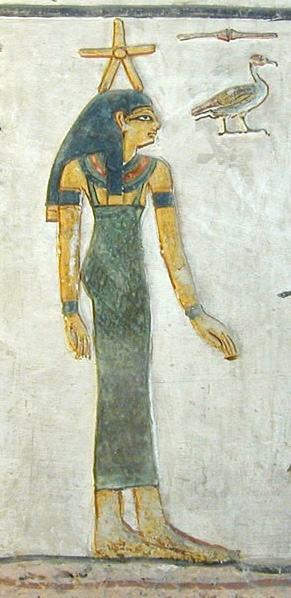
If you’ve been reading this blog, no doubt, you already know that Her star is the star Sirius. This Latin name is the one by which She is most well known today. The Greeks called Her Sothis, which is just the Greek version of Her Egyptian name, Sopdet. She is the brightest star in the night sky and Her name means “sharp” because of the long, glittering, multi-hued and sharp-looking rays of light that extend from Her celestial being.
From at least the time of the Pyramid Texts, if not significantly before, the star Sopdet is associated with Isis. The Pyramid Texts tell us,
Your [Osiris’] sister Isis has come to You, rejoicing/aroused for love of You. You have placed Her on Your phallus and Your seed issues into Her, She being ready as Sothis, and Horus Soped has emerged from You as Horus Who is in Sothis.
—Pyramid Text 366
Star Lore
Knowledge of the star was vitally important to the ancient Egyptians because the heliacal rising (just before the sun) of the Star of Isis signaled the coming of the Inundation flood that nourished Egypt’s fields, as well as the start of the Egyptian New Year.
To acknowledge Isis’ ancient connection with Her star, some shrines and temples of Isis, including the small Isis temple at Ptolemaic-era Dendera, were oriented towards Sopdet.
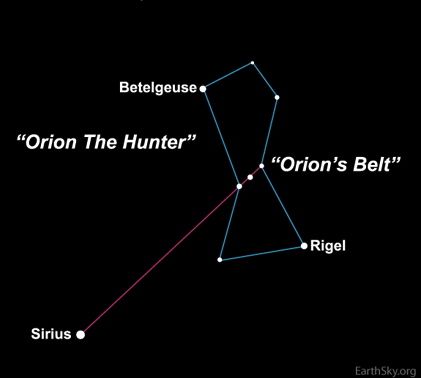
If your own skies are clear at night, it is easy to spot the Star of Isis in the northern hemisphere. She is to the lower left of the extremely easy-to-spot constellation of Orion, which has always looked to human beings like a human torso. The ancient Egyptians called the constellation Sah and associated it with Osiris.
Orion has been visualized as a Great Shepherd, Hunter, Warrior, or simply a Giant. And since every shepherd or hunter must have his hunting hound, Sirius itself, as well as the constellation in which it is the lead star, has been envisioned as a Great Dog. Interestingly, this is true in cultures throughout the world, from ancient Mesopotamia to China (where Sirius is a wolf) to Native North American tribes like the Blackfoot, who called it Dog-Face, and the Inuit, who called it the Moon Dog. (The Wikipedia article on Sirius seems to be pretty good and includes references.) Surely it was envisioning Orion as a shepherd, hunter, or warrior that led so many ancient peoples to see Sirius and its constellation as a companion dog.
Heliacal Rising?
Sirius cannot be seen during a period of about 70 days, from sometime in May to sometime around or after midsummer. Before this time, Sirius and the sun are in conjunction so that the sun’s greater light blocks the visibility of Sirius. The heliacal rising of Sirius is when the star and sun are sufficiently separated so that—for the first time in 70 days—Sirius can be seen on the horizon just before dawn. (See below for a calculator for when She rises in your area.)
In the northern hemisphere, this occurs in the hottest part of the year. From Classical times, this period has been known as the “Dog Days” since the Dog Star of Sirius is once again visible. This hot part of the year can be miserable indeed. Homer knew it as a time of fevers and suffering. The Romans thought it made dogs act crazy. We think of it as a time when we’re panting like a dog because of the heat.

While the ancient Egyptians didn’t have the Sirius-dog connection, when Egypt came under Greek, and then Roman, rule, Isis gained Her canine-star connection. (In Egypt, She had been associated with the Canine God Anubis very early on.) In a later-period aretalogy from Kyme in modern Turkey, Isis says of Herself, “I am She that riseth in the Dog Star.”
Sopdet could also be considered the Ba—the manifestation or “soul”—of Isis. In the same way, the constellation Sah is Osiris’ Ba. In the skies, since Orion rises before Sirius, we can see the ancient myth of Isis searching for Her lost husband playing out before our eyes as the Orion constellation moves through the sky ahead of the Beautiful Star of Isis. In the “Lamentations of Isis and Nephthys,” Isis says to Osiris, “Your sacred image, Orion [Sah] in heaven, rises and sets every day; I am Sothis following after Him and I will not forsake Him.”
There is an additional interpretation of the movement of the stars through the sky that takes us to an even more important point in the Isis-Osiris story. When the Orion constellation first appears on the horizon, Osiris seems to be on his back, with Iset-Sopdet rising beneath Him. As the night passes and the constellation rises higher into the sky, He “stands up,” with Isis at His back all the while, pushing upward until the God is raised.

Even more than the myth of Isis following Osiris to pick up the pieces, we can see Isis raising Osiris from the dead in the skies above. We can understand this as the stellar model of the ritual of Raising the Djed Column, which the pharaoh, with the help of Isis, performed on earth.
New Sirius Rising Calculator
In looking back on some of my earlier posts on this subject, I discovered that the online calculator I’ve been linking to—the one that lets you calculate when Sirius rises in your area—is no longer available.
However, thanks to KnightSpectral on r/Kemetic on reddit, I can share with you a new, free, online calculator. It’s from in-the-sky.org. Just give it a date in summer near when you think Sirius might rise in your area (try starting on July 1st, for instance), and let it use your local time. Then look down the resulting chart until you no longer see “Not observable” and instead see a date and time. That’s your local rising time and date.
I’ll share this link again in summer as we await the rising of the brilliant Star of Isis. But we have another star mystery coming January 1. And we can talk about that later.

 Isiopolis